

Refine
Sort by
Base station
Suction power
Navigation
Smart features
Brand
Customer rating
More like this

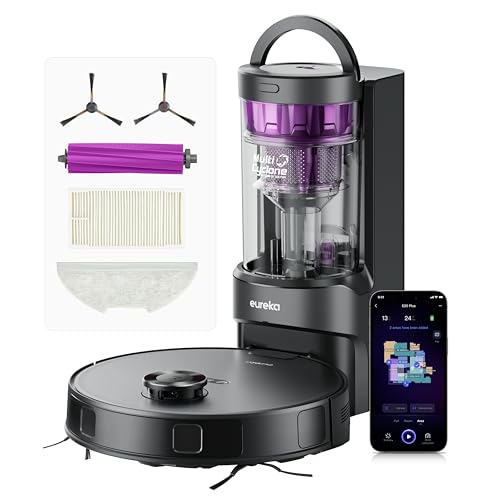
Eureka E20 Plus Robot Vacuum Cleaner (Black, 35cm x 35cm)
Eureka
- 8000Pa powerful suction
- 45-day self-emptying station
- 10mm mop lifting
- 180-minute battery life
- AI obstacle avoidance

Dreame Robot vacuum cleaner with mop
Dreame
- 4000Pa powerful suction
- LiDAR navigation mapping
- 150 minute battery life
- 2-in-1 vacuum and mop
- App and Alexa control
Looking for the best robot steam mops usually means one thing: you want floors that feel genuinely clean underfoot, not just damp. This guide explains what “steam” means on a robot, which machines really use heat, the floors where heat is safe (and where it isn't), and how the models in our range compare on real figures from their spec sheets.
What is a robot steam mop?
A traditional steam mop boils water and pushes vapour through a microfibre pad, so the heat does much of the work on grease and grime. A robot version tries to do the same job on its own: it maps your home, vacuums, then mops with heat instead of cold water.
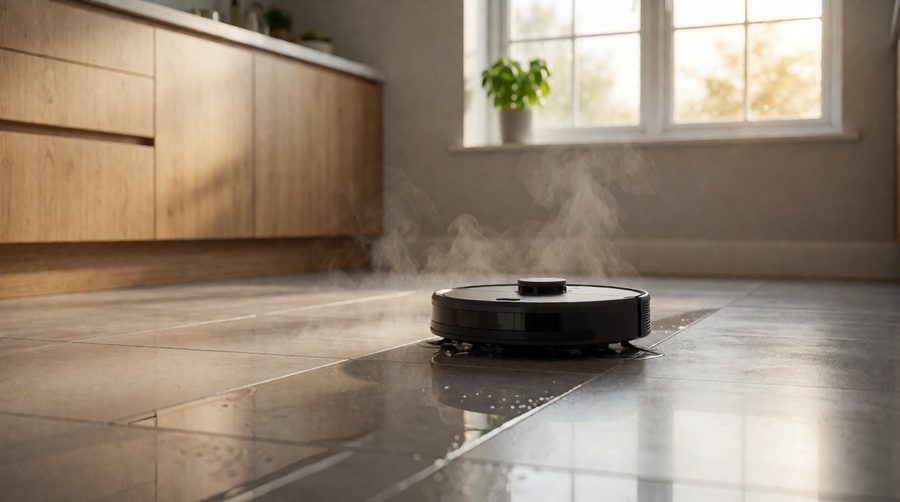
Until recently that was mostly marketing. Very few robots carry a boiler, because steam needs a lot of power and a battery-driven machine has little to spare. Instead, brands moved the heat into the docking station, where mains power is available. There are now three kinds of heated cleaning to know about:
- True steam on the floor - the robot itself releases steam onto stains before mopping. This is brand new and expensive.
- Hot water on the floor - the mop is fed with heated water as it cleans, so the pad stays warm while it scrubs.
- Hot water mop washing - the robot mops with cool water, but the dock rinses the pads at 40-80°C and dries them with warm air between jobs. This is by far the most common, and it is what most of the models above do.
Do true steam robots exist yet?
Yes, but only just. At IFA 2026 Dreame showed the Aqua20 Pro Ultra Roller X Complete, which it describes as releasing 180°C steam through four outlets to soften dried-on marks before its roller mop goes over them. Dreame also quotes 100°C hot water for washing the roller in the dock and 40,000Pa suction, and the UK price was announced as £1,299, with stock due later in the year. Dreame says its steam process removed 99.999% of bacteria in SGS testing - a lab figure, not something you'll measure at home.
Narwal has gone a slightly different route with the Flow 2: its roller is fed with 60°C water from 16 nozzles while it mops, and the dock washes the roller with water heated to 100°C. That is not steam, but it is hot water on the floor for the whole run, which is the next best thing for greasy kitchens.
For now, those are flagship machines. If your budget is closer to £300-£700, hot water mop washing is where you'll find the value, and it still makes a clear difference to how fresh the pads smell and how well they clean the next time.
Hot water mop washing: why the dock temperature matters
A cold-wash robot rinses its pads in tap water and leaves them damp in the base. In a warm kitchen, that's how pads start to smell after a few days. Hot water helps dissolve the grease the pads picked up, and warm air drying stops them sitting wet. The result is a cleaner pad going back onto the floor each time.
Here's how the heated models in our collection compare, using the figures listed in each product's specs:
| Model | Mop wash temp | Drying | Suction | Mop lift | Run time | Best for |
|---|---|---|---|---|---|---|
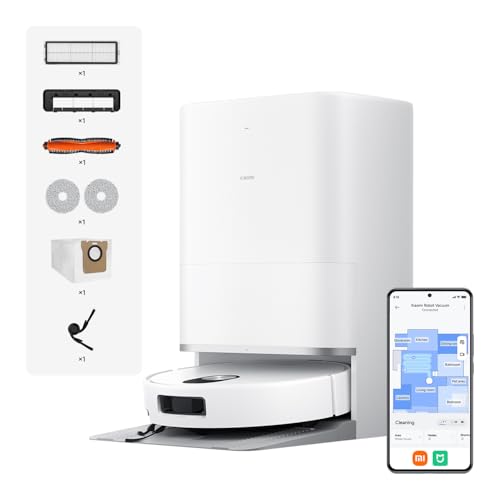
| Xiaomi 5 Pro | 80°C | - | 20,000Pa | - | 120 min (90 at max) | Best for the hottest pad wash |
| Ecovacs Deebot X8 Pro Omni | 40 / 55 / 75°C | 63°C hot air | 18,000Pa | 10mm | - | Best for choosing the wash temperature |
| Eureka J15 Pro Ultra | 75°C | 55°C | 16,200Pa | 12mm | 100 min | Best for homes with thicker rugs |
| Ecovacs Deebot T50 Pro Omni | 75°C | 45°C hot air | 15,000Pa | - | 60 min (as listed) | Best for low sofas and beds |
| Xiaomi H50 Pro | Auto mop washing | - | 15,000Pa | 10mm | 120 min | Best for large tanks |
| Dreame D9 Max (cold water) | No dock wash | - | 4,000Pa | - | 150 min | Best value cold-water option |
| Dreame Aqua20 Pro Ultra Roller X Complete* | 100°C + 180°C steam | - | 40,000Pa | - | - | Best for true steam (coming soon) |
* Announced for the UK at £1,299; not yet in our product range. A dash means the figure isn't listed.
Two things stand out. First, the dock temperature varies a lot - from 40°C on the X8's gentlest setting to 80°C on the Xiaomi 5 Pro. Second, the cheaper cold-water machines like the Dreame D9 Max often run for longer on a charge, because they aren't carrying a heavy roller or feeding a big station. If you want the heated wash, check the station too: these docks are bulky, and the Xiaomi 5 Pro's is listed at 44.3 x 43.1 x 68.6cm.
Which floors are safe for heat and steam?
This is the part most buying guides skip, and it matters more than suction. Heat and moisture together can damage some floors, and a robot will happily repeat the same mistake every day. Which? advises that tiles are a great match for steam, that unsealed hardwood should be avoided because sudden changes in heat and moisture can warp it, that steam can strip the sealer from stone, and that vinyl can lose its shape and loosen its glue under heat.
| Floor | True steam | Hot water on the floor | Hot-washed pads, normal mopping |
|---|---|---|---|
| Ceramic and porcelain tiles | Yes - the ideal match | Yes | Yes |
| Sealed hardwood | Low setting only, keep it moving | Yes, low water flow | Yes |
| Engineered wood | Check the maker's care guide first | Low water flow | Yes |
| Laminate | Low setting only, or avoid | Low water flow | Yes, low water flow |
| Vinyl and LVT | Avoid | Check the maker's advice | Yes, pH-neutral cleaner only |
| Natural stone | Avoid - can strip the sealer | Check the sealer | Yes |
| Unsealed, oiled or waxed wood | No | No | Dry vacuum only |
The good news is that hot water mop washing is safe on far more floors than steam, because the heat stays in the dock and the pad reaches the floor warm-damp, not scalding. That's one reason it's the sensible choice for mixed homes. For specific advice, see our guides to robot mops for hardwood floors, robot mops for laminate and robot mops for vinyl plank flooring. Luxury vinyl makers such as Karndean recommend sweeping and then mopping with a pH-neutral cleaner, which a normal robot mop does well.
Choosing the best robot steam mops for your home
1. Decide how much heat you actually need
If you mainly fight dust, paw prints and the odd spill, a robot with hot water mop washing gives you fresher pads and a better finish without the price of true steam. If you cook a lot, have tiled floors throughout and want the closest thing to a manual steam mop, the new steam and hot-water-roller flagships are worth waiting for.
2. Look at the mop system, not just suction
Suction figures (Pa) get the headlines, but on a heated mopper the pad matters more. Rollers, like the OZMO roller on the Ecovacs X8 Pro Omni, are rinsed constantly as they turn, so they put less dirty water back down. Twin spinning pads press harder and reach corners well. A simple vibrating pad, as on many budget models, is fine for light daily wipes but won't shift dried-on marks.

3. Mop lifting for rugs
A heated, damp pad dragged across a rug is not what you want. Check the mop lift height: 10mm on the Ecovacs X8 Pro Omni and Xiaomi H50 Pro, 12mm on the Eureka J15 Pro Ultra, and 8mm on the Roborock Q10 S5+. Higher lifts cope better with thicker rugs, and some docks remove the pads entirely for carpet-only runs.
4. Station size and water tanks
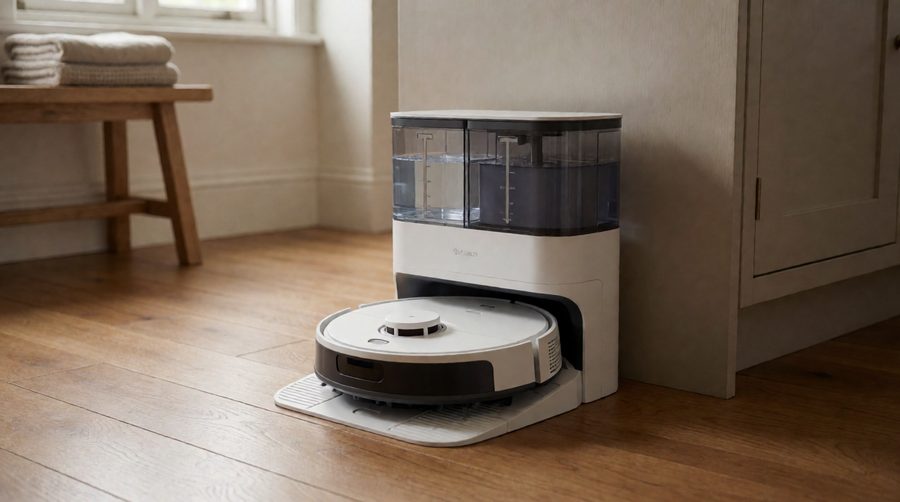
Every heated model here uses a dock with a clean water tank and a dirty water tank; the Xiaomi H50 Pro lists 4 litres clean and 3.2 litres dirty. Bigger tanks mean fewer refills on large floors. Measure the space first - these stations are much taller than a basic charging pad. Our robots with dirty water tanks collection shows more options.
5. Cleaning solution compatibility
Many docks can add a dose of floor cleaner automatically. Only use the brand's own solution or one it approves, because the wrong product can foam or damage the pump. If you'd like this feature, see our robot mops that use cleaning solution.
6. Height and edges
Low furniture is where dust collects. The Ecovacs T50 Pro Omni is 8.1cm tall, while most rivals sit around 9.3-9.7cm. For skirting boards, look for an extending mop or side brush, such as Ecovacs' TruEdge 2.0.

7. Noise and runtime
Listed noise levels range from 55dB on the Dreame D9 Max to 71dB on the Narwal Freo X Plus. If you'll run it while you're home, our quiet robot vacuum and mop picks are worth a look. Runtime varies from about 60 minutes to 200 minutes (the Proscenic Q8 Max), so in a large house the dock's recharge-and-resume feature matters.
Robot steam mop vs a handheld steam mop
A manual steam mop is still the most powerful way to sanitise a tiled floor, and it costs far less. What it won't do is clean every day while you're out. A robot won't scrub a single stubborn spot as hard, but its daily runs stop grime building up in the first place. Many households end up with both: a robot for everyday upkeep and a handheld steamer for a monthly deep clean of the bathroom and kitchen.
- Choose a robot if you want daily, hands-off cleaning, have pets or children, and have mostly sealed hard floors.
- Keep a manual steamer for grout lines, worktops and occasional deep sanitising.
- Combine them if your floors are tiled and you want the best of both.
Our product range at a glance
Our pick of the best robot steam mops in stock is below. The collection above mixes heated and standard models so you can compare. For a heated dock, start with the Xiaomi 5 Pro, the Ecovacs Deebot X8 Pro Omni, the Eureka J15 Pro Ultra and the Ecovacs Deebot T50 Pro Omni.

If you have shedding pets, our robot vacuum mops for pet hair put more weight on tangle-free brushes. For the full fully-automatic experience, see our self-cleaning robot mop and vacuums, or compare the top-end premium robot mops against our budget-friendly robot mops.
Keeping a heated robot mop working well
- Empty the dirty water tank after every run - warm, grey water is what makes stations smell.
- Use the drying cycle - leave hot air drying switched on, even if it adds a little noise.
- Watch for limescale - in hard water areas, heated stations scale up faster. Follow the maker's descaling advice and consider filtered water.
- Replace pads or rollers when they stop releasing dirt in the wash, typically every few months.
- Clear hair from the brushes weekly so the robot isn't dragging debris through the mop.
Frequently asked questions
Is there a robot mop that really uses steam?
Yes. Dreame's Aqua20 Pro Ultra Roller X Complete is one of the first robot mops to release steam (quoted at 180°C) onto the floor, with a UK price of £1,299. Most others wash their mops in hot water at the dock instead.
Is hot water mop washing as good as steam?
Not quite for dried-on stains, because the floor itself isn't heated. But it keeps the pads much cleaner and fresher, which improves every clean, and it's safer for more floor types.
Can I use a robot steam mop on laminate?
Laminate can swell if moisture gets into the joints. Hot-washed pads with a low water flow are fine on most sealed laminate. Avoid true steam unless the flooring maker approves it.
Are they safe on vinyl and LVT?
Steam is generally not recommended on vinyl because heat can loosen the adhesive. A normal robot mop with a pH-neutral cleaner is the safer approach.
Do robot steam mops work on carpet?
They vacuum carpets, but they shouldn't mop them. Look for automatic mop lifting (8-12mm in our range) or pads that detach in the dock.
Do heated robot mops use more electricity?
Heating water in the dock does draw extra power during the wash and dry cycle, so expect higher use than a cold-wash model. The robot itself runs from its battery.
How hot does a robot mop wash its pads?
In our range: 75°C on the Eureka J15 Pro Ultra and Ecovacs T50 Pro Omni, up to 75°C on the Ecovacs X8 Pro Omni (with 40°C and 55°C options), and 80°C on the Xiaomi 5 Pro.
Still comparing? The Ecovacs robot mops range and our all-in-one robot mops with charging stations are good places to continue, and independent test results are published by Which? robot vacuum reviews.