

Refine
Sort by
Base station
Suction power
Navigation
Battery life
Smart features
Colour
Brand
Customer rating
More like this


Shark PowerDetect Robot Vacuum
Shark
- 5x PowerDetect cleaning technologies
- 60-day self-emptying capacity
- 3D LiDAR navigation mapping
- Sonic mopping with pad washing
- NeverStuck threshold climbing technology
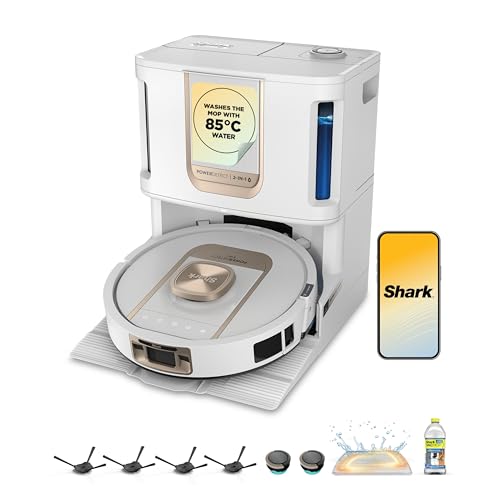
Shark ThermaCharged PowerDetect Robot Vacuum
Shark
- Heated mop cleaning base
- Dirt detect technology
- Edge cleaning extension
- Three hour battery life
- Auto water tank refill

Narwal Freo X Plus Robot Vacuum And Mop (White)
Narwal
- 7800Pa powerful suction
- Seven weeks dust storage
- Zero tangle brush design
- Self-emptying dustbin technology
- Tri-laser obstacle avoidance

Dreame X50 Ultra
Dreame
- 20,000Pa Vormax suction power
- Retractable legs climb 2.36in
- VersaLift lowers to 3.5in
- DuoBrush anti-tangle system
- Auto-empty self-cleaning base

Ecovacs Deebot X11 OmniCyclone
Ecovacs
- 19,500Pa BLAST suction power
- Bagless auto-empty station
- OZMO ROLLER 2.0 mopping
- PowerBoost 3-minute charging
- ZeroTangle anti-hair wrap

Eufy X10 Pro Omni
Eufy
- 8,000 Pa powerful suction
- Auto mop washing station
- Self-emptying dust collection
- AI obstacle avoidance
- Dual rotating mop pads
What is a self-cleaning robot vacuum and mop?
It is a 2-in-1 robot vacuum cleaner that vacuums and mops in the same run, then drives back to a docking station that cleans its mop for you. The base sprays fresh water over the pads or roller, scrubs them against ribs in a tray and pumps the grey water into a separate tank. Better docks then blow warm air across them so nothing sits damp and starts to smell.
The phrase gets used loosely. Some listings call a robot vacuum "self-cleaning" because the brush roll cuts away tangled hair, or because the base empties the bin. Those features are useful, but they are not the same thing. If you only want the bin emptied, our self-emptying robot mops cost less. A true self-cleaning model looks after the wet side of the cleaning as well - the part nobody wants to touch.
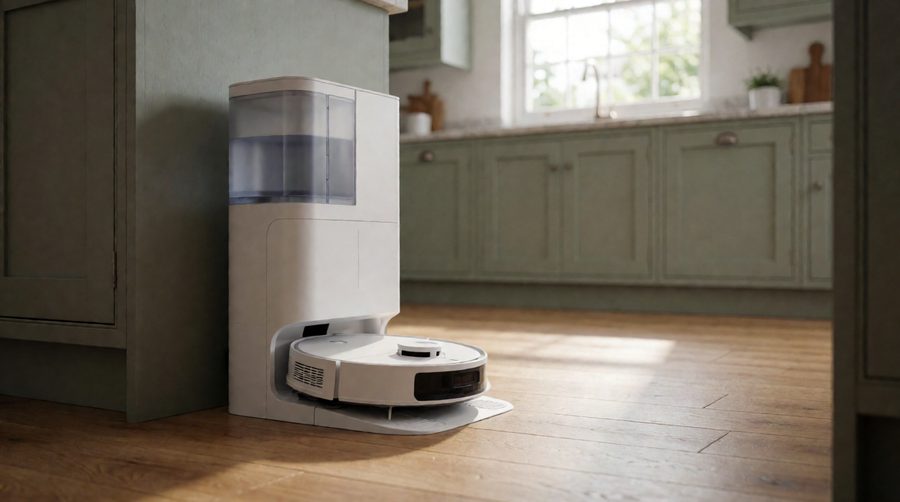
How the self-cleaning dock works
Each brand has its own name for it - Shark NeverTouch, Dreame ThermoHub, Ecovacs OZMO Roller, Eufy HydroJet - but the cycle is much the same:
- The robot vacuum finishes a room, or a zone you set in the app, and returns to the base.
- Fresh water from the clean tank is sprayed onto the pads or roller while they turn in the tray.
- Grey water is pumped into a sealed tank, so it never goes back on the floor.
- Many docks refill the robot's onboard tank and add a measured dose of cleaning solution.
- Suction from the base pulls dust, dirt and debris out of the robot vacuum's bin into a bag or bagless container.
- When the job is done, heated air dries everything, which stops odour and mildew.
On longer jobs the robot comes back mid-clean to rinse, so it is not dragging kitchen grime into the hallway. That automatic mop washing is the whole point of these machines.
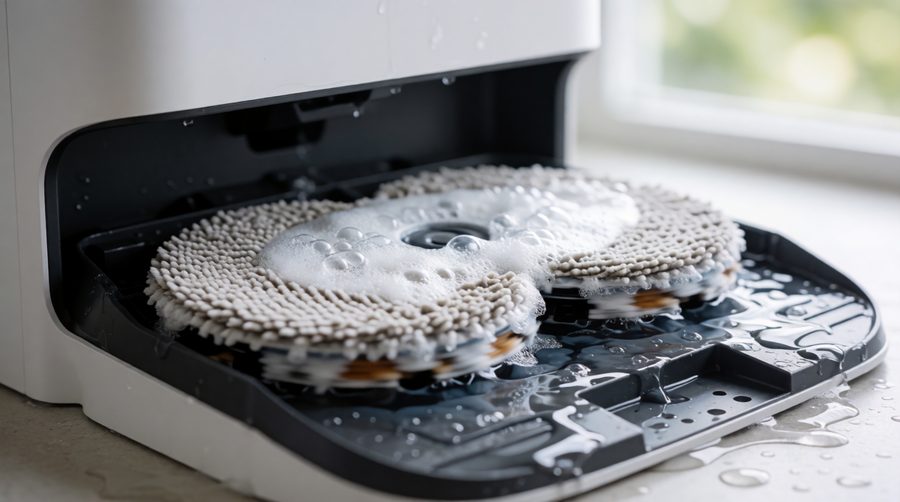
Self-cleaning vs self-emptying
| What the base does | Self-emptying base | Self-cleaning (all-in-one) dock |
|---|---|---|
| Empties the dust bin | Yes | Yes, on almost all |
| Washes the mopping head | No - you rinse it by hand | Yes, after and often during each run |
| Dries it afterwards | No | Usually, with warm or heated air |
| Refills the robot | No | Yes, from a clean tank |
| Size | Compact | Tall and deep - plan the space |
Our all-in-one robot mops with charging stations and auto empty robot vacuums cover the wider range if you are still deciding how much the base needs to do.
Types of self-cleaning mop
Rotating pads
Two round pads spin and press down on the floor. This is the most common design and it works well on dried-on marks. The Roborock Qrevo Edge 2 presses down with 8N of force, and the Eufy X10 Pro Omni spins at 180 RPM with 1kg of pressure. Most lift by around 10-12mm on reaching a rug: 12mm on the Eufy and 10.5mm on the Dreame L50 Ultra.

Roller mops that clean as they go
A long cylindrical roller is rinsed and scraped clean inside the robot vacuum all the way round the room, so you are always mopping with fresh water rather than a cloth that gets dirtier by the minute. The Eufy E25 Omni, the Ecovacs Deebot X11 and X12 OmniCyclone (OZMO Roller), the Mova Z60 Ultra Roller with its 12-nozzle rinse and the Lefant M5 Pro with a 20cm roller all work this way.

Vibrating (sonic) pads
A flat pad scrubs back and forth instead of spinning. The Shark Stratos scrubs up to 100 times a minute, and its NeverTouch base cleans and dries it for up to 30 days hands-free. These suit lighter, everyday mopping more than heavy stains.
Self-cleaning robot vacuum cleaners compared
Figures are the manufacturers' own, taken from the specs in our product feed. A dash means the figure is not listed.
| Model | Suction power | Mop type | Wash | Drying | Battery runtime |
|---|---|---|---|---|---|
| Roborock Qrevo Edge 2 | 25,000 Pa | Rotating pads | 80°C | 55°C | - |
| Shark ThermaCharged PowerDetect | - | Pad | 85°C | 80°C | 3 hours |
| Eureka J15 Max Ultra | 22,000 Pa | Rotating pads | Up to 80°C | 55°C | 360 mins |
| Xiaomi 5 Pro | 20,000 Pa | Extendable mop | 80°C | - | 120 mins |
| Ecovacs Deebot X11 OmniCyclone | 19,500 Pa | Roller | 75°C | 63°C | 200 mins |
| Lefant M5 Pro | 18,000 Pa | Roller | 75°C | 2-4 hours, set in app | 180 mins mopping |
| Ecovacs Deebot T30S Pro | 11,000 Pa | Rotating pads | 70°C | Heated | 180 mins |
| Eufy E25 Omni | 20,000 Pa | Roller | Rinsed while cleaning | 35-50°C | 180 mins |
| Eufy X10 Pro Omni | 8,000 Pa | Rotating pads | Cold | 45°C | 180 mins |
| Mova Z60 Ultra Roller | 28,000 Pa | Roller | Hot | Heated | 3.5 hours |
Suction power in Pa helps the robot vacuum pull dirt, debris and pet hair out of carpets, but for mopping the wash temperature, downward pressure and drying matter more.
Other brands are joining in. Tapo sells the RV50 Omni with auto mop washing and removal, iRobot pairs its Roomba Combo robots with an AutoWash dock, and Dyson's Spot+Scrub AI targets stains with a scrubbing roller - so expect the choice of self-cleaning robot vacuum cleaners to keep growing.
How to choose a self-cleaning robot vacuum and mop
Before comparing models, decide which of these jobs you want the base to handle:
- Hot or cold mop washing
- Heated drying
- Auto-emptying, and for how many days
- Automatic refilling and detergent dosing
- Lifting or detaching the mopping head on carpets
Hot or cold washing
Cheaper docks rinse cold. A hot wash shifts greasy kitchen residue far better, and the temperature varies a lot: 70°C on the Ecovacs T30S Pro, 80°C on the Roborock Qrevo Edge 2 and 85°C on the Shark ThermaCharged. Dreame now advertises a 100°C ThermoHub system on its newest docks. Browse the hot water robot vacuum mops if this matters most to you.
Heated drying
Anything left damp in a closed base soon smells. Warm air drying, from 35-50°C on the Eufy E25 Omni up to 80°C on the Shark, avoids that. It also matters for allergy sufferers: Allergy UK points out that dust mites and mould thrive in damp, humid conditions, and it recommends a high-filtration (HEPA) vacuum cleaner for hard floors. The Eufy E25 Omni and Shark Stratos both use HEPA filters.
Tank sizes and hands-free days
Tank sizes decide how often you have to step in. The Eufy X10 Pro Omni carries 3 litres of clean water, which Eufy says covers a 150 sq m home two or three times. Bin claims run from 30 days on the Shark Stratos to 100 days of auto-emptying on the Dreame L50 Ultra. See our robot mops with a dirty water tank for more on tank designs.

Detergent dosing
Some docks hold a bottle of floor cleaner and add the right amount each time; the Dreame L50 Ultra holds 200ml of cleaning solution. Use only the solution the manufacturer approves, as foaming cleaners can damage pumps. Our robot mops that use cleaning solution all support this.
Carpets, rugs and thresholds
Look for carpet detection with automatic lifting or, better, a mopping head that detaches at the base before carpet cleaning. The Mova Z60 Ultra Roller lifts its roller and drops a shield to keep carpets dry, and climbs thresholds up to 8cm. For older homes with raised door bars, see robot vacuums that climb thresholds.
Navigation, mapping and obstacle avoidance
Lidar or dToF laser navigation maps each floor of your home so the robot vacuum cleans in neat rows and knows which rooms to wet-clean, and the app lets you set no-go zones and a different routine for each floor type. Camera-based obstacle avoidance, often paired with lidar, helps with cables and socks: Roborock lists 280+ object types for the Qrevo Edge 2, and Dreame 180+ for the L50 Ultra. Our obstacle avoidance robot vacuums go further into this.
Pet hair
Pet hair and fluffy debris wrap round brushes and clog trays, so this robot vacuum feature matters in a pet home. Anti-tangle brushes (Ecovacs ZeroTangle, Roborock's dual anti-tangle system) and a base that scrapes its own tray, like the Eureka J15 Max Ultra, keep things running. More options are in our robot vacuum and mops for pet hair.
Size of the base
All-in-one docks are big. The Roborock Qrevo Edge 2 base measures 48.7 x 52.1 x 34cm and the Dreame L50 Ultra stands 68.6cm tall, so measure the spot and leave room to lift the tanks out.
Best floors for self-cleaning mopping
In most UK homes, sealed hard floors gain most: tile, vinyl, laminate and sealed wood. On wooden floors, choose a robot vacuum that controls water flow and leaves little moisture behind - Roborock says the Qrevo Edge 2 is designed to be gentle on hardwood. See our picks for hardwood floors and tile floors. Unsealed wood, waxed floors and natural stone that dislikes moisture are best left to vacuuming alone.
Prices and value
Which? puts robot vacuum cleaners at around £200 to more than £1,000, and full self-cleaning docks sit in the upper half of that. Prices on Amazon change daily, so check the live price on each product. For less outlay, look at our budget robot vacuum cleaners and mid-range models; for flagship docks with hot washing and detachable mopping heads, see premium models.
Dock maintenance
Self-cleaning cuts the work, but it does not remove it. A quick maintenance routine keeps the base fresh:
- Empty and rinse the grey water tank every few days - do not leave it standing.
- Wipe out the tray and its filter about once a week, as hair and grit collect there.
- Refill the clean tank and the solution bottle when the app asks.
- Replace the dust bag when full and wash or change the filter as the manual says.
- Replace the pads or roller when they wear thin, usually every few months.
If you want the least effort of all, our low maintenance robot mops focus on bigger tanks and self-cleaning trays.
FAQs
Do self-cleaning robot mops really stay clean?
They stay far cleaner than a robot vacuum cleaner without a wash station, because the cloths are rinsed during and after every run. Hot washing does the best job on grease. You will still need to replace pads from time to time and clean the tray.
How often do I need to empty the grey water tank?
It depends on tank size, floor area and how dirty your floors are, but in a typical home it is every few days. The app warns you when it is full.
Is hot washing worth paying extra for?
If you mop a kitchen, or live with pets and children, yes. At 70-85°C the dock lifts grease and sticky residue that a cold rinse leaves behind, and heated drying stops any smell.
Can I put my own floor cleaner in the dock?
Use only the cleaning solution the manufacturer approves. Ordinary floor cleaners can foam, damage the pumps and sensors, and may affect your warranty.
Will a self-cleaning robot vacuum and mop wet my rugs?
Not if it has carpet detection. Most lift 10-12mm or leave the mopping head at the base while vacuuming carpet, and some add a shield over the roller.