

Refine
Sort by
Base station
Suction power
Navigation
Battery life
Smart features
Colour
Brand
Customer rating
More like this
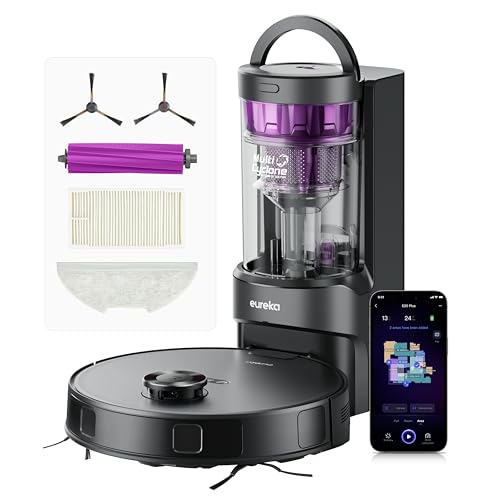
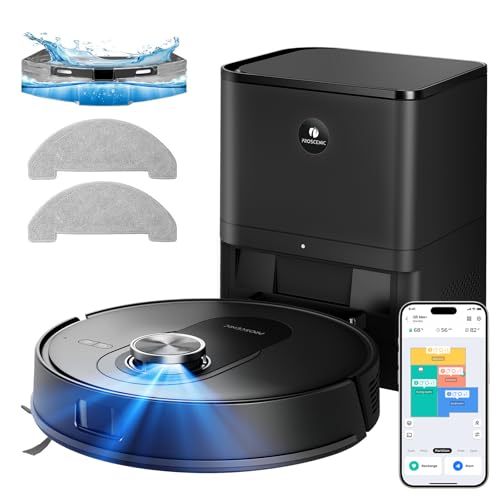


Shark Stratos robot vacuum
Shark
- 30 days hands-free cleaning
- Sonic mopping technology
- 360° LiDAR navigation
- Self-cleaning brush roll
- HEPA filtration system

Lefant Robot vacuum cleaner
Lefant
- 18,000Pa powerful suction
- 20cm wide roller mop
- 75°C hot water washing
- 120 days hands-free cleaning
- dToF laser navigation mapping

Mova Mobius 60 MopSwap Robot Vacuum
Mova
- 30,000 Pa suction power
- Three interchangeable mops
- Crosses 8cm obstacles
- Hot water cleaning station
- HEPA filtration system

Shark Stratos robot vacuum
Shark
- 30 days hands-free cleaning
- Self-emptying NeverTouch base
- Sonic mopping technology
- 360° LiDAR mapping
- AutoLift carpet protection

Tapo RV30 Max Plus Robot Vacuum Cleaner (5300Pa, Black)
Tapo
- 5300Pa hyper suction power
- LiDAR dual navigation mapping
- Auto-empty dock included
- Vacuum and mop functions
- 150 minutes battery life

Samsung Jet Bot Combo+ VR7MD96514G (Misty White, 3-in-1)
Samsung
- 3-in-1 vacuum and mop
- Self-emptying Clean Station
- Steam mop sanitisation
- AI object recognition
- SmartThings app control

Ecovacs Deebot T50 Pro Omni (Black)
Ecovacs
- 15,000Pa powerful suction
- Ultra-slim 3.19" design
- Self-emptying omni station
- AI obstacle avoidance
- TruEdge corner cleaning

Lefant Lefant M2 Plus Robot Vacuum
Lefant
- 6000Pa powerful suction
- Self-emptying station included
- LiDAR navigation mapping
- 2-in-1 vacuum and mop
- 140 minute battery life


Xiaomi Robot Vacuum Cleaner
Xiaomi
- 20000Pa powerful suction
- Self-cleaning base station
- 80°C hot water cleaning
- Retractable LiDAR navigation
- Extendable mop pads
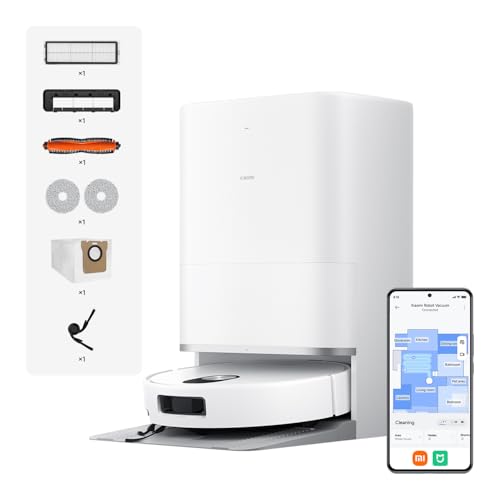
Xiaomi 5 Pro
Xiaomi
- 20,000Pa powerful suction
- AI obstacle recognition
- Self-cleaning base station
- 80°C hot water washing
- LiDAR navigation system

Ecovacs DEEBOT T50 PRO OMNI Gen 3
Ecovacs
- 15,000Pa powerful suction
- Ultra-slim 8.1cm design
- Self-cleaning mop station
- AI obstacle avoidance
- Auto-empty dustbin function

Eureka E20 Plus Robot Vacuum (Black, 35.1cm x 35.1cm)
Eureka
- Bagless self-emptying station
- 8000Pa powerful suction
- LiDAR navigation system
- Anti hair-tangling brush
- 2-in-1 vacuum mop

Dreame L50 Ultra robot vacuum
Dreame
- 19,500Pa powerful suction
- Auto-empty base station
- Self-cleaning mop system
- Obstacle avoidance technology
- 180-minute battery life

Mova Ultra Roller Robot Vacuum
Mova
- 28,000Pa ultra suction power
- Anti-tangle dual brush system
- AutoShield carpet protection technology
- Self-cleaning mop washing station
- Edge-to-edge cleaning coverage

Ecovacs Deebot T30S Robot Vacuum Cleaner And Mop (Black)
Ecovacs
- 11,000Pa powerful suction
- Hot water mop washing
- ZeroTangle anti-hair technology
- TruEdge adaptive edge mopping
- All-in-one OMNI station

Eureka Eureka J15 Pro Ultra Robot Vacuum Cleaner
Eureka
- 16,200Pa powerful suction
- Self-cleaning base station
- Hot water mop washing
- AI obstacle avoidance
- FlexiRazor anti-hair tangling

Dreame D20 Air Plus
Dreame
- 20,000Pa powerful suction
- Auto-empty base station
- LiDAR smart navigation
- Anti-tangle brush design
- 2-in-1 vacuum and mop

Shark Matrix RV2310AE robot vacuum
Shark
- Matrix Clean precision grid
- Self-empties for 45 days
- 360° LiDAR mapping
- Self-cleaning brushroll
- Bagless base system

Shark PowerDetect Robot Vacuum And Mop (White, 60-Day Self-Emptying)
Shark
- 60-day self-emptying capacity
- 3D LiDAR vision mapping
- Sonic mopping technology
- PowerDetect cleaning sensors
- Anti-allergen complete seal
What are obstacle avoidance robot vacuums?
A robot vacuum with obstacle avoidance has obstacle detection sensors on its front, low down near the floor, whose only job is to see what is in its path. Ordinary robots find things by driving into them. These spot an item first, measure it and decide whether to slow down, edge around it or give it a wide berth.
The simplest systems just sense that an obstacle is there. Better ones use obstacle recognition to work out what it is: a cable, a sock, a shoe or pet waste. That matters, because a robot should keep well clear of a dog accident but can clean right up to a table leg. Most of the models in this range are robot vacuum and mop combos, so good avoidance also stops a wet mop dragging through a spill or over a rug.
Why it matters in a real home
A robot vacuum is meant to clean while you're at work or asleep. Unless it can avoid obstacles on its own, it needs babysitting:
- Cords and chargers get wound round the brush and stop the run.
- Socks, tea towels and drawstrings get sucked up and jam the suction inlet.
- Pet waste gets spread across the floor, the worst outcome by far.
- Toys and small items get pushed under furniture or swallowed.
- Chair and table legs get bumped hundreds of times, leaving scuffs on paintwork and furniture.
- Stuck alerts mean a half-cleaned floor when you get home.
Good obstacle avoidance doesn't mean you'll never tidy up first, but it cuts the number of rescues dramatically.
How robot vacuums detect and avoid obstacles
Each brand gives its system a name (AIVI 3D, PrecisionVision, ReactiveTech, IntelliView), but underneath they're built from the same handful of sensor types, usually several at once.
Bump and cliff sensors
The whole front bumper is a switch: the robot turns when it hits something. Sensors underneath look for a drop so it doesn't fall down the stairs. Every robot has both, but a bump sensor only reacts after contact, so it does nothing for a sock or a cable.
LiDAR: mapping, not avoidance
The spinning turret on top is LiDAR. It sweeps a laser round the room to build an accurate map and find walls and big furniture, which is what makes room-by-room cleaning and no-go zones possible (see our robots with mapping). Because it sits several centimetres above the floor, it looks straight over low items. A robot vacuum can map your home perfectly and still run over a phone charger.
Infrared, PSD and line lasers
Cheaper models use infrared proximity or PSD (position sensitive detector) sensors to measure the distance to anything ahead. Lefant's M2 Plus, for example, uses a 190° PSD array. Line laser systems project one or more bright lines across the floor and watch how they bend over an object. They work well in the dark, but they can only tell you something is there, not what it is.
3D structured light
A projector casts an infrared dot or grid pattern in front of the robot, and a sensor reads how the pattern warps over objects. That gives a 3D shape, so it can tell a low cable from the floor and judge its height. Roborock's ReactiveTech and the Dreame L50 Ultra rely on structured light.
Time of flight (dToF)
Time of flight sensors time a light pulse's journey out and back to measure distance very precisely. Many 2026 models use a retractable or embedded dToF unit instead of a tall LiDAR turret, which lowers the robot so it fits under more furniture.
AI cameras and object recognition
A front camera, backed by software trained on thousands of images, identifies objects by type. This is where the "recognises 150+ objects" claims come from. A camera alone struggles in dim rooms, so the best robot vacuum systems add a small built-in light, structured light or a laser. iRobot's PrecisionVision on the Roomba j7 was built to spot cables and pet waste in real time.
| Sensor type | What it does well | Weak spots | Typical price level |
|---|---|---|---|
| Bump + drop sensors | Stops falls, finds walls | Only reacts after contact | Every robot |
| LiDAR | Fast, accurate room maps | Sits too high to see low items | Most mid-range and up |
| Infrared / PSD / line laser | Detects things ahead, works in the dark | Can't tell what an object is | Budget to mid-range |
| 3D structured light | Measures shape and height, sees cables | No identification without a camera | Mid-range |
| AI camera | Identifies object types, treats pet waste differently | Needs light; privacy questions | Upper mid-range and flagship |
| Camera + structured light / laser | Recognition plus depth, day or night | Cost | Flagship |
Obstacle avoidance systems in our range compared
These figures come from the product listings in this collection, so you can compare like with like. The object count is the brand's own figure for how many object types the system recognises.
| Model | Obstacle system | Objects recognised | Suction | Climbs |
|---|---|---|---|---|
| Ecovacs Deebot T50 Pro Omni | AIVI 3D 3.0: 3D camera + 3D structured light | 100+ | 15,000 Pa | - |
| Ecovacs Deebot T80 Omni | AIVI 3D 3.0 + LiDAR | 100+ | 18,000 Pa | - |
| eufy E25 Omni | Laser + AI recognition | 200+ | 20,000 Pa | - |
| Xiaomi 5 Pro | 3D active avoidance + AI recognition | 200+ | 20,000 Pa | 20mm |
| Dreame L50 Ultra | 3D structured light | 180+ | 19,500 Pa | 6cm (ProLeap) |
| Eureka J15 Max Ultra | LiDAR + IntelliView AI camera | 150+ | 22,000 Pa | - |
| Roborock Q10 S5+ | ReactiveTech structured light, LiDAR | - | 10,000 Pa | - |
| Narwal Freo X Plus | Tri-laser + LiDAR | - | 7,800 Pa | - |
| Lefant M5 Pro | PSD 2.0 sensors | - | 18,000 Pa | 2cm |
| Mova Mobius 60 | Retractable dToF | - | 30,000 Pa | 5cm single, 8cm combined |
Two things stand out. First, the object count and the suction figure don't go together: the strongest suction here (Mova's 30,000 Pa) comes with a distance sensor rather than a named recognition library. Second, the camera-plus-depth systems from Ecovacs, eufy, Xiaomi and Eureka are the ones that can tell a sock from a slipper. If you mostly fight cables and pet mess, prioritise recognition. If you mainly need to get over door bars, look at climbing height.


How to choose a robot vacuum with obstacle avoidance
Look at the front sensors, not the LiDAR
Ignore the mapping system when judging obstacle avoidance. Look for an AI camera, 3D structured light, dToF or a line laser named as the obstacle detection system. Camera plus a depth sensor is the strongest combination.
Check how many objects it recognises
A library of 100-200+ object types means the robot reacts differently to a cable, a shoe and pet waste. A system without recognition treats everything as a generic block, which is fine for chair legs but less good for a stray sock.
Make sure it copes in the dark
If it runs at night or under beds, you need a model with an onboard light, a laser or structured light. A camera-only system loses accuracy in dim rooms.
Match the climbing height to your thresholds
Most robot vacuums manage about 2cm. Older homes with raised door bars need more: the Dreame L50 Ultra lifts 6cm and the Mova Mobius 60 crosses 5cm single steps and 8cm combined. Our threshold-climbing robot vacuums list the figures.
Check the height under your furniture
A tall laser turret can stop a robot vacuum reaching under a low sofa. Slim designs like the 8.1cm Deebot T50 Pro Omni, or the Xiaomi 5 Pro that gets under 9.5cm gaps, clean where clutter collects. For small spaces see our small robot mops.
Pets and children
For dogs, cats and toddlers, AI pet waste recognition and good cable detection matter more than raw suction. Pair that with anti-tangle brushes; our robot vacuum and mops for pet hair cover the brush side.
Think about the camera and your privacy
A camera robot drives round your home taking images. Pick a brand that processes images on the device, lets you turn off remote video and gets regular firmware updates. The NCSC's guide to smart devices explains how to set them up safely. If you'd rather have no camera at all, choose structured light, PSD or a laser system instead.

The hardest things for a robot vacuum to avoid
Independent testers agree the same things catch robots out. Vacuum Wars runs every robot through a 24-object course, and RTINGS scores the worst of three runs across shoes, socks, USB and extension cables, a steel pet bowl and fake pet waste. The usual problem items are:
- Thin charging cords and loose drawstrings lying flat
- Socks and tea towels, especially on patterned rugs
- Dark or black items on dark floors
- Shiny, angled things like steel pet bowls
- Soft, wet pet mess
- Very small toys and bricks
No system is perfect. Treat obstacle avoidance as fewer rescues, not permission to leave everything on the floor.
Carpet, rugs and low light
On carpet and rugs
Carpet makes obstacle detection harder: a grey sock on a grey rug barely stands out, and long pile hides thin cords. Robot vacuum and mop combos add a second job here, lifting the mop (10mm on the Eureka E20 Plus, 8mm on the Roborock Q10 S5+) or leaving it in the dock so a rug doesn't get soaked. Check the listing for carpet detection and mop lifting if you have rugs over hard floors.
In low light
Low light is where camera-only systems slip. Robot vacuums that pair the camera with structured light, a line laser or an onboard LED keep recognising obstacles under beds and after dark, so they're the safer choice for night-time cleaning schedules.
Which robot vacuum with obstacle avoidance suits your home?
- Pets and toddlers: an AI camera trained to spot animal mess, such as the Eureka J15 Max Ultra or eufy E25 Omni.
- Cables and clutter everywhere: camera plus 3D structured light, like the Ecovacs Deebot T50 Pro Omni.
- Raised door bars: the Dreame L50 Ultra (6cm) or Mova Mobius 60 (8cm combined).
- Low sofas and beds: a slim 8.1-9.5cm body, such as the Deebot T50 Pro Omni or Xiaomi 5 Pro.
- Tight budget: PSD or laser sensors, like the Lefant M5 Pro, and a quick tidy before each run.
- Want a familiar brand: see our Roomba vacuum and mops and Shark robot vacuum and mops.
Is obstacle avoidance worth paying for?
It's worth it if the robot will run while nobody's home, if you have pets or children, or if there are always a few cables on the floor. If your floors are clear before every run, a cheaper LiDAR robot from our budget robot vacuum and mops will do the job.
- Budget: PSD or line laser sensors that detect objects but don't identify them (Lefant M5 Pro and M2 Plus).
- Mid-range: 3D structured light or tri-laser that judges shape and height (Roborock Q10 S5+, Narwal Freo X Plus). See our mid-range robot vacuum and mops.
- Flagship: AI cameras with depth sensing and libraries of 100-200+ objects (Ecovacs Deebot, eufy, Xiaomi, Eureka). Our premium robot mops sit here.
Getting the most from your robot
- Run the first clean in daylight with the floor fairly clear so it builds a good map.
- Draw no-go zones in the app around cable nests, pet bowls and the bottom of the stairs.
- Wipe the front camera and sensor window regularly; dust and pet hair blur them.
- Keep firmware updated, as brands improve object recognition over time.
- Check the app's obstacle log or photos to see what it avoided and what it didn't.
- Pick up anything you can't afford to lose, like earrings or Lego, before a run.
Most brands let you schedule runs and add zones from the app or by voice; see our smart robot vacuum cleaners and Ecovacs robot mops.
Obstacle avoidance FAQs
Is LiDAR the same as obstacle avoidance?
No. LiDAR on top maps the room. Obstacle avoidance uses separate sensors on the front, close to the floor, to see small items the LiDAR looks over.
Will a robot vacuum avoid dog poo?
Camera models trained to spot pet waste usually will, though no robot avoids soft mess every time. The Roomba j7's PrecisionVision and the camera systems from Ecovacs, eufy and Eureka are built for it. Check the floor after an accident before you start a run.
Do obstacle avoidance robots avoid cables and socks?
Mostly. Camera and structured light models handle these obstacles far better than laser or PSD-only robots. Thin cords lying flat are still the hardest test.
Does obstacle avoidance work in the dark?
Laser, structured light and dToF sensors work in the dark. Camera systems need their own light or a depth sensor to keep recognising objects at night.
Do all robot vacuums have obstacle avoidance?
No. Many cheaper robot vacuums rely on bump and drop sensors with basic infrared, which find walls and furniture but not small obstacles on the floor.
Are camera robot vacuums safe for privacy?
Choose a brand that processes images on the robot, lets you switch off remote viewing and updates its firmware. Use a strong app password and turn on two-step login.