

Refine
Sort by
Base station
Suction power
Navigation
Battery life
Smart features
Colour
Brand
Customer rating
More like this
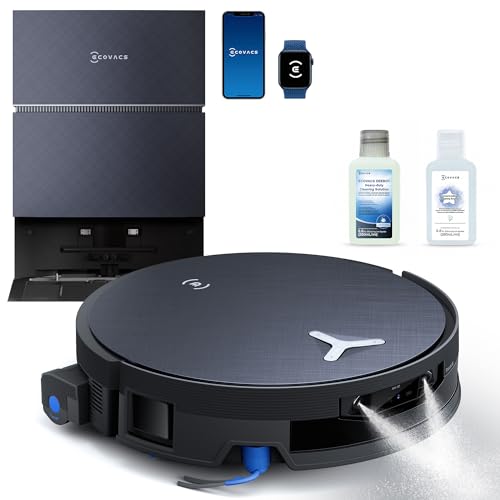
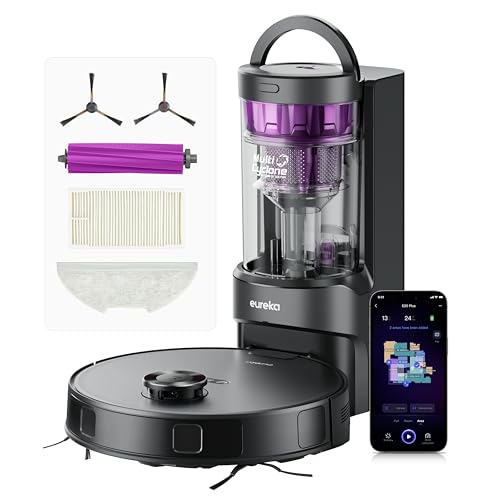


Shark PowerDetect Robot Vacuum And Mop (White, 60-Day Self-Emptying)
Shark
- 60-day self-emptying capacity
- 3D LiDAR vision mapping
- Sonic mopping technology
- PowerDetect cleaning sensors
- Anti-allergen complete seal

Ecovacs Deebot T80 Omni (Black)
Ecovacs
- OZMO roller mopping system
- 18,000Pa suction power
- ZeroTangle 3.0 technology
- Smart OMNI station
- Voice control compatible
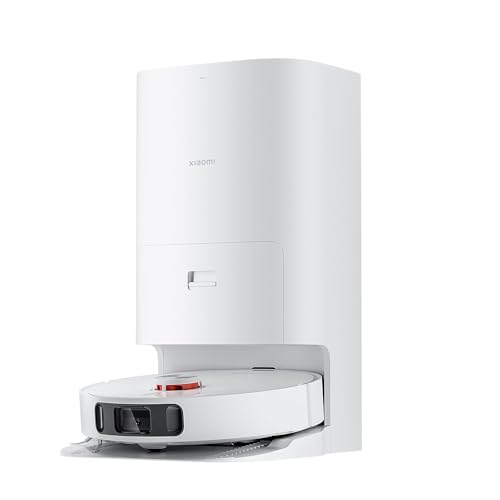
Xiaomi Mi Robot Vacuum Cleaner X10+
Xiaomi
- 4000Pa super suction power
- Self-cleaning rotating mop pads
- Auto-empty dust station
- AI obstacle avoidance technology
- 120-minute battery life
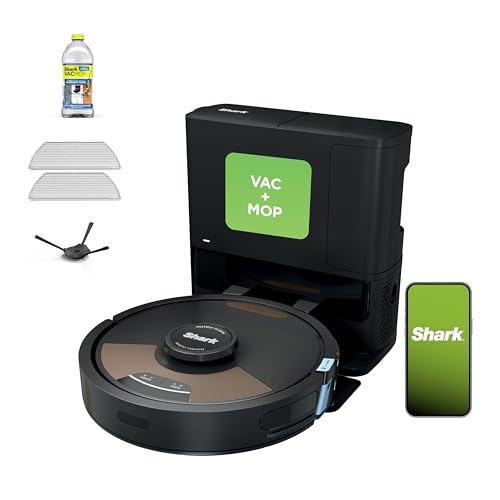
Shark Matrix Plus
Shark
- Self-emptying 60-day capacity
- Sonic mopping technology
- Matrix Clean grid pattern
- HEPA filtration system
- 360° LiDAR mapping

Shark PowerDetect Robot Vacuum
Shark
- 5x PowerDetect cleaning technologies
- 60-day self-emptying capacity
- 3D LiDAR navigation mapping
- Sonic mopping with pad washing
- NeverStuck threshold climbing technology
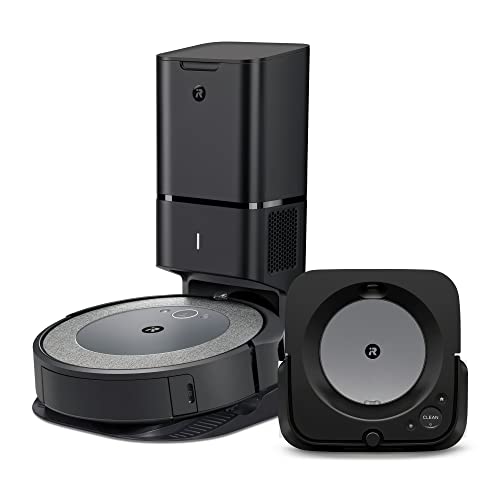
Irobot Roomba i3+ EVO 3550 Bundle
iRobot
- Self-emptying Clean Base station
- Smart mapping technology
- Premium 3-stage cleaning system
- Precision Jet Spray mopping
- Voice and app control

Narwal Freo X Plus Robot Vacuum And Mop (White)
Narwal
- 7800Pa powerful suction
- Seven weeks dust storage
- Zero tangle brush design
- Self-emptying dustbin technology
- Tri-laser obstacle avoidance

Dreame X50 Ultra
Dreame
- 20,000Pa Vormax suction power
- Retractable legs climb 2.36in
- VersaLift lowers to 3.5in
- DuoBrush anti-tangle system
- Auto-empty self-cleaning base

Ecovacs Deebot X11 OmniCyclone
Ecovacs
- 19,500Pa BLAST suction power
- Bagless auto-empty station
- OZMO ROLLER 2.0 mopping
- PowerBoost 3-minute charging
- ZeroTangle anti-hair wrap

Eufy X10 Pro Omni
Eufy
- 8,000 Pa powerful suction
- Auto mop washing station
- Self-emptying dust collection
- AI obstacle avoidance
- Dual rotating mop pads

Irobot Roomba Combo i8+
iRobot
- Self-emptying clean base
- Vacuum and mop combo
- Smart mapping technology
- Voice control compatible
- Four stage cleaning

Irobot Roomba Combo j7
iRobot
- Retractable mop system
- PrecisionVision obstacle avoidance
- Smart mapping technology
- 4-stage cleaning system
- Voice control compatible
What is a self emptying robot vacuum and mop?
It is a 2-in-1 robot vacuum cleaner that also mops hard floors and comes with a docking station, also called a base station, that pulls the dirt out of its onboard dustbin. When the robot vacuum returns to charge, a powerful fan in the base sucks the debris through a port underneath and into a large bag or bin. The robot vacuum's own bin is small, usually under half a litre, while the base holds anything from 2 to 4 litres, which is why one bag can last weeks.
That one feature changes how a robot fits into your week. Without it, you empty the bin after almost every clean. With it, the robot vacuum can run on a schedule every day and you only touch the dirt when the app says the dust bag is full. That is what makers mean by hands-free cleaning.
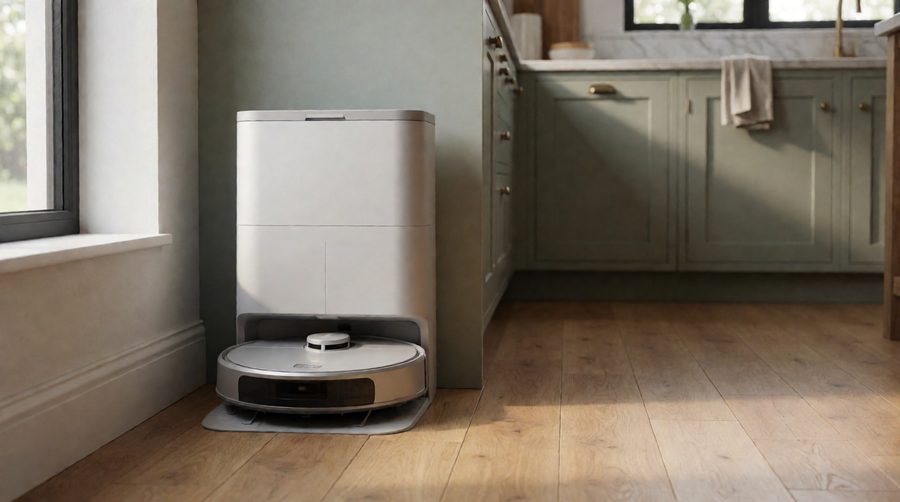
How the auto-empty base works
- The robot finishes a run, or stops halfway when the bin is full, and drives back to the base.
- It lines up with the evacuation port, and the station runs its fan for around 15-30 seconds.
- Dust, pet hair, crumbs and other debris travel up a channel into a sealed dust bag or a cyclonic bin in the base station.
- The robot charges and, on all-in-one stations, the mop pads are washed, then hot air drying stops them smelling before the next job.
- When the bag is full, the app sends an alert. You lift out the bag, which closes as you remove it, and drop in a new one.
The empty cycle is loud for a few seconds. Shark, for example, lists 70-75dB for the empty on its PowerDetect base against 55-60dB while cleaning, so most owners set the schedule for when they are out.
Types of self-emptying station
Not every auto-empty base does the same job. There are three broad types, and the one you pick decides how much upkeep is left for you.
| Station type | What it does | What you still do | Examples in our range |
|---|---|---|---|
| Basic auto-empty (bagged) | Empties the robot's bin into a sealed bag | Fill the robot's small water tank, rinse the mop pad | Tapo RV30 Max Plus, Proscenic Q8 Max+ |
| Bagless auto-empty | Empties into a cyclonic bin you tip out | Empty the bin over the rubbish bin, wash its filter | Eureka E20 Plus, Shark PowerDetect, Ecovacs Deebot X12 Pro |
| All-in-one (Omni / Ultra) | Empties, refills clean water, washes and dries the mops, often with hot water | Top up the clean tank, empty the waste tank, change the bag | Roborock Qrevo Edge 2, Dreame L50 Ultra, Ecovacs Deebot T50 Pro Omni |
Bagged stations
Bags seal shut as you lift them out, so very little dust escapes. That makes them the better choice for allergy sufferers. The catch is the running cost and waste: each base takes its own branded bag, and third-party bags that fit poorly can stop the emptying working.
Bagless stations
A bagless station spins the debris into a clear bin. There is nothing to buy, but emptying it is a little dustier. Dyson's Spot+Scrub Ai takes this approach too: its cyclonic dock uses 10 cyclones, stores dry debris for up to 100 days and also cleans and refills the wet roller. If you like the idea, our bagless robot vacuum mops are all built this way.
All-in-one stations
The top tier adds a clean water tank and a dirty water tank to the base. These self-cleaning stations refill the robot, scrub the mop pads or roller and use hot air drying so they don't smell. Roborock, Dreame, Eufy and Ecovacs all sell Omni or Ultra versions. Many also wash with hot water, from 70°C up to 80°C on the models in our range. Want one that tackles mop hygiene first? Compare our hot water robot vacuum mops and robot mops with a dirty water tank.

Auto-empty robot vacuum and mop models compared
These figures come from the product specifications on our own listings, so you can compare like with like. Hands-free days are the makers' claims, based on typical use.
| Model | Suction | Run time | Hands-free emptying | Base and mop |
|---|---|---|---|---|
| Tapo RV30 Max Plus | 5,300 Pa | 150 min | Up to 2 months, 3L bag | Basic bag base, mop pad |
| Proscenic Q8 Max+ | 8,000 Pa | 200 min | 60 days, 3L bag | Bag base, lifts mop on carpet |
| Eureka E20 Evo Plus | 10,000 Pa | 180 min | 45 days | Bagless, 10mm mop lift |
| Shark PowerDetect (60-day) | Not stated | 110 min | 60 days | Bagless, sonic mopping |
| Narwal Freo X Plus | 7,800 Pa | Not stated | 7 weeks | Auto-empty, LiDAR |
| Lefant M5 Pro | 18,000 Pa | Up to 180 min mopping | 120 days | Roller mop, 75°C wash |
| Dreame L50 Ultra | 19,500 Pa | 180 min | 100 days | All-in-one, 10.5mm mop lift |
| Eureka J15 Max Ultra | 22,000 Pa | 360 min | 75 days, 4L bag | 80°C wash, 55°C drying |
| Roborock Qrevo Edge 2 | 25,000 Pa | Not stated | 65 days | 80°C wash, 55°C drying |
| Mova Z60 Ultra Roller | 28,000 Pa | 3.5 hours | Auto-empty | Roller mop, climbs up to 8cm |
Two things stand out. Suction varies more than five-fold, from 5,300 Pa on the Tapo to 28,000 Pa on the Mova, and the hands-free claim runs from 45 days to 120. A bigger number is not automatically better, though. A small flat with hard floors will be spotless with 5,000-8,000 Pa, while thick carpets and a moulting dog justify paying for more.
Self-emptying vs standard robot vacuum and mop
The robot itself is often identical. Several brands sell the same vacuum with a plain charger or with an auto-empty base, so the real choice is about the base and how much hands-on work you want.
| Standard robot vacuum and mop | Self-emptying model | |
|---|---|---|
| Dustbin | Emptied by hand after most runs | Emptied by the base; you change a bag or bin every few weeks |
| Scheduled daily cleaning | Stops when the small bin fills | Runs day after day without you |
| Dust when emptying | A puff of dust each time | Sealed bag, or one larger empty |
| Space needed | A small charging plate | A tower 36-69cm tall on our models |
| Ongoing costs | Filters and brushes | Filters, brushes and dust bags (bagged bases) |
| Best for | Occasional cleaning, tight budgets | Daily cleaning, pets, allergies, busy homes |
If you already own a robot vacuum and are tired of emptying it, check whether the maker sells a compatible auto-empty base before replacing the whole machine. iRobot, for instance, has long sold Roomba models with and without its Clean Base.
There's also a middle route. The iRobot Roomba i3+ EVO bundle in our range pairs a self-emptying robot vacuum with a separate Braava jet m6 mopping robot, so each machine does one job well. For most homes, though, a single 2-in-1 robot vacuum cleaner with an auto-empty base is simpler and takes up less room.
Pros and cons of a robot vacuum that empties itself
Why it's worth it
- Weeks without touching dirt. You stop emptying a tiny bin after every run.
- Daily cleaning becomes realistic. With a full bin no longer stopping it, the robot vacuum can clean on a schedule every day.
- Less dust in the air. A sealed bag keeps allergens in, rather than a puff of dust each time you tip a bin.
- Better for pets. Fur fills a small bin fast; the base swallows a week or more of moulting.
- Mopping that stays fresh. On all-in-one stations, washed and dried pads don't leave a sour smell.
The downsides
- Running costs. Replacement bags, filters and pads add up over a year.
- Size. An auto-empty base is far bigger than a plain charger. In our range, station heights run from 36cm on the Narwal Freo X Plus to 68.6cm on the Dreame L50 Ultra.
- Noise. The empty is loud, if short.
- Water tanks still need attention. Unless the station is plumbed in, you fill the clean tank and empty the dirty one every few runs.
How to choose the right model
Suction power
Suction power is quoted in pascals (Pa). Around 5,000 Pa handles hard floors and low rugs; 10,000 Pa and above pulls grit and dirt out of carpet pile more reliably. Look for carpet boost, which raises suction power automatically on rugs, and a rubber main brush plus a side brush that reaches into corners. Roborock's Qrevo and Saros ranges, Dreame's Ultra models and the Mova Z60 sit at the top end, and our high suction robot mops gather them together.
Mopping system
Basic models drag a damp microfibre pad. Better ones use spinning pads or vibrating plates that scrub, and the newest use a roller mop that is cleaned continuously as it turns. Check for mop lifting: the pads rise 10-12mm on carpet, or the robot leaves them in the base, so rugs stay dry.
Navigation and obstacle avoidance
Almost every self-emptying model now uses LiDAR navigation and mapping, which lets you set no-go zones and clean room by room in the app. Camera-based obstacle avoidance adds the ability to steer round socks, cables and pet mess, and the best obstacle avoidance systems recognise dozens of objects. If your floors are cluttered, start with our obstacle avoidance robot mops.
Run time and home size
Battery life across our range runs from 110 minutes up to 360, though runtime drops on maximum suction. For a flat, two hours is ample. For a large house, check that the robot vacuum recharges and resumes where it left off; our robot mops for large areas are chosen for that.
Thresholds and rugs
Most robots climb 20mm. If you have raised door bars or thick rugs, look for 4cm or more. The Mova Z60 Ultra Roller lists up to 8cm. Our threshold climbing robot mops are filtered for this.
Smart features
Nearly all of these work with an app for schedules, maps and suction levels, and most add voice control through Alexa or Google Assistant. The app is also where you see when the dust bag is nearly full. With voice control you can start, pause or send the robot vacuum home without opening the app at all. If you want to start a clean by voice, see our Alexa-compatible mopping robots.
Best picks for different homes
Hard floors in a smaller home
A bagged base with a simple pad, like the Tapo RV30 Max Plus, keeps upkeep low without paying for features you won't use. Our robot mops for hard floors and budget robot mops cover this end of the market.
Pet owners
Pet hair is where an auto-empty base earns its keep, as fur fills a small onboard bin in a single run. Pick strong suction, a rubber or anti-tangle brush and a large dust bag. Our robot vacuum mops for pet hair are picked with this in mind.
Allergy sufferers
Choose a bagged station so the dust is sealed in, and look for a fine filter. The NHS advises using a vacuum with a HEPA filter and damp dusting as ways to cut exposure to house dust mites, a common trigger of allergic rhinitis. Allergy UK's dust mite factsheet likewise recommends a high-filtration vacuum and regular cleaning of hard floors.
Busy family homes with mixed floors
An all-in-one station is worth it here. The Roborock Qrevo Edge 2, Dreame L50 Ultra and Ecovacs Deebot range wash and dry the mops themselves, so daily mopping doesn't create a smelly pad. Browse the full range of all-in-one robot mops.
Large homes with lots of carpet
Go for high suction power, carpet detection and a long runtime. The Eureka J15 Max Ultra lists 360 minutes and 22,000 Pa, and the Mova Z60 Ultra Roller 3.5 hours and 28,000 Pa, so either can vacuum a big floor plan before returning to the docking station.

Living with an auto-empty robot: upkeep and costs
Hands-free doesn't mean maintenance-free. An auto-empty robot cuts the daily chores, but the base and robot still need a little maintenance to keep suction and mopping at their best.
| Task | How often | Why |
|---|---|---|
| Change the dust bag or empty the bin | When the app alerts you, usually every 1-4 months | A full bag stops the base emptying the robot |
| Empty and rinse the waste tank | After every few mopping runs | Stops smells and residue |
| Top up the clean tank | Every few mopping runs | The station can't refill the robot when it's empty |
| Remove hair from the main and side brush | Weekly with pets, otherwise fortnightly | Tangled hair reduces pick-up |
| Wash or replace filters | As the manual says | Keeps suction power up |
| Wipe sensors and charging contacts | Monthly | Helps navigation and reliable docking |
In practice, that means:
- Change the bag when the app tells you; how long it lasts depends on floor area, pets and how often you clean.
- Empty the waste tank on all-in-one stations after a few mopping runs, and rinse it so it doesn't smell.
- Clean the brushes. Cut hair off the main and side brush every week or two.
- Wash or replace filters as the manual says, and wipe the sensors and charging contacts.
- Replace mop pads when they wear thin.
To keep bag costs down, use the official bags and let the base fill properly rather than changing a half-full one. If you'd rather not buy bags at all, a bagless base removes that cost.
Keep the robot vacuum charging on its own dock with the supplied lead. The London Fire Brigade warns against cheap counterfeit chargers for anything with lithium batteries and advises keeping electrical items in good working order.

Where to put the dock
A self-emptying station needs a permanent spot, and placement affects how well the robot vacuum finds its way home. Follow the manual, but these rules apply to almost every model:
- Against a wall on a hard, level floor, not on a thick rug, so the robot vacuum lines up with the emptying port.
- Clear space either side and in front, so the vacuum can turn and dock without bumping into furniture.
- Away from stairs, so the robot vacuum doesn't approach the dock along the top step.
- Near a socket, ideally with the cable tucked into the base's storage channel.
- Room above the lid to open the top and lift out the bag or dust bin. Tall all-in-one stations won't slide under most kitchen units.
- Somewhere central if you can, as the robot vacuum covers more floor per charge when it starts in the middle of the home.
Hallways, utility rooms and the end of a kitchen run are popular spots. On a multi-storey home, the robot vacuum usually stores several maps, but the base lives on one floor; you carry the robot upstairs and it vacuums there without self-emptying until it comes back down. Our multi-floor robot mops handle several maps well.
Leading robot vacuum cleaner brands
- Roborock - Qrevo and Saros models with strong suction and hot-water mop washing. The Roborock Qrevo Edge 2 in our range lists 25,000 Pa.
- Ecovacs - the Deebot T and X Omni lines, including OmniCyclone stations that need no bags. See our Ecovacs robot mops.
- Dreame and Mova - high suction, roller mops and robots that climb raised thresholds.
- Shark - bagless self-empty bases with sonic mopping. See our Shark robot vacuum mops.
- Eufy, Tapo, Eureka and Lefant - good value, from simple bag bases to full Omni stations like the Eufy X10 Pro Omni, which lists 8,000 Pa and 180 minutes.
- Dyson - the Spot+Scrub Ai, a wet and dry robot vacuum cleaner with an 18,000 Pa motor, a self-cleaning wet roller and a cyclonic dock.
- iRobot - the Roomba Combo range and Clean Base. Take care: only "+" models include the auto-empty base.
For an independent view, Which? tests robot vacuum cleaners in UK homes and reports on cleaning and running costs.
Quick buying checklist
- Bagged or bagless base station - bagged for allergies, bagless to avoid buying bags.
- Basic auto-empty or all-in-one - do you want the station to wash and dry the mops?
- Suction power to suit your floors - 5,000 Pa for hard floors, 10,000 Pa or more for carpet and pet hair.
- LiDAR navigation, mapping and no-go zones in the app.
- Obstacle avoidance if your floors are often cluttered.
- Mop lifting or carpet detection if you have rugs.
- Runtime long enough for your floor area.
- Space for the docking station, with room to open the lid.
Self emptying robot vacuum and mop FAQs
How often do you empty a self-emptying robot vacuum?
Typically every 1-4 months. In our range, makers claim 45 days for the Eureka E20 Plus, 60 days for Shark and Proscenic, 100 days for the Dreame L50 Ultra and 120 days for the Lefant M5 Pro. Pets and daily cleaning shorten that.
Do all robot vacuum and mops have a self-emptying base?
No. Many are sold with a plain charging dock, and some brands sell the same robot with or without the base. Check the name: iRobot uses a "+", while others say Plus, Omni or Ultra.
Are self-emptying docks loud?
Yes, but only briefly. The emptying cycle lasts seconds and is louder than cleaning. Shark quotes 70-75dB. Schedule it for when you're out, or choose from our quiet robot vacuum and mops for quieter cleaning.
Do I still need to empty the water tank?
On basic stations you fill the robot's small water tank by hand. All-in-one docks refill the robot automatically, but you still top up the clean tank and pour away the dirty one, unless you buy a plumbed-in model.
Can I use a self-emptying robot on carpet?
Yes. Look for carpet detection and mop lifting, or a station that leaves the pads behind when the robot vacuums carpeted rooms.
Can I use non-branded dust bags?
You can, but fit matters. A bag that doesn't seal properly against the base can stop the vacuum emptying fully or let dust escape. Official bags are the safe choice, at least until you've seen how a third-party pack fits.
Will a self-emptying robot work upstairs?
Yes, if it can store more than one map. Carry it up, and it vacuums and mops the upper floor, then you bring it back to the base to empty and charge. Some owners buy a second plain charger for upstairs.
Is a self emptying robot vacuum and mop worth the extra money?
If you'd use the robot vacuum most days, yes. The base is what turns a gadget you supervise into one that simply keeps the floors clean in the background. If you'd only run it once a week, a standard robot vacuum with a small bin may be enough. Our robot vacuum and mop range covers both options.
Are bagless self-emptying stations better?
They save on bags, but emptying them is dustier. Bagged stations are better if anyone at home has a dust allergy.