

Refine
Sort by
Base station
Suction power
Navigation
Battery life
Smart features
Colour
Brand
Customer rating
More like this

Dreame X50 Ultra
Dreame
- 20,000Pa Vormax suction power
- Retractable legs climb 2.36in
- VersaLift lowers to 3.5in
- DuoBrush anti-tangle system
- Auto-empty self-cleaning base

Ecovacs Deebot X11 OmniCyclone
Ecovacs
- 19,500Pa BLAST suction power
- Bagless auto-empty station
- OZMO ROLLER 2.0 mopping
- PowerBoost 3-minute charging
- ZeroTangle anti-hair wrap

Eufy X10 Pro Omni
Eufy
- 8,000 Pa powerful suction
- Auto mop washing station
- Self-emptying dust collection
- AI obstacle avoidance
- Dual rotating mop pads

Irobot Roomba j7
iRobot
- PrecisionVision obstacle avoidance
- 10x power-lifting suction
- Smart mapping technology
- Pet hair resistant brushes
- App and voice control

Irobot Roomba Combo i8+
iRobot
- Self-emptying clean base
- Vacuum and mop combo
- Smart mapping technology
- Voice control compatible
- Four stage cleaning

Irobot Roomba Combo j7
iRobot
- Retractable mop system
- PrecisionVision obstacle avoidance
- Smart mapping technology
- 4-stage cleaning system
- Voice control compatible
What makes a robot vacuum and mop quiet?
Every robot vacuum makes some noise. The fan that creates suction is the loudest part, followed by the spinning brushes, the wheels and, on a robot mop, the motor that spins or vibrates the mop pads. A quiet model keeps all of those down: a well-insulated fan, a brushless motor, rubber brushes that do not slap the floor and a body that does not rattle.
Most makers quote the noise level in decibels (dB). In this range the listed figures run from 40dB on the HONITURE G20 PRO to 71dB on the Narwal Freo X Plus. That spread matters more than it looks, because the decibel scale is not linear.
- Fan and suction power - the biggest source of vacuum noise. Higher suction settings and carpet boost are always louder.
- Brushes - stiff bristles are noisier on hard floors than rubber, and hair wrapped round the roller makes it louder still.
- Mopping system - spinning mop pads, a roller mop or a vibrating plate each add a hum of their own.
- The base station - emptying the dustbin, washing mop pads and hot air drying all happen at the dock, often after the clean has finished.
| Noise source | When you hear it | How to cut it |
|---|---|---|
| Suction fan | All through the clean, loudest on carpet | Quiet or eco mode, carpet boost off in quiet rooms |
| Main roller and side brushes | On hard floors, and when hair builds up | Clear hair weekly, choose rubber rollers |
| Mop pads or roller mop | While mopping | Low water flow and mop-only passes on hard floors |
| Bumps and scraping | Around chair legs, sofas and door bars | LiDAR mapping, no-go zones, tidy cables before a run |
| Self-emptying dock | A few seconds after each clean | Dock away from bedrooms, empty only once a day |
| Mop drying fan | For hours after a mopping clean | Shorter drying time or air-dry the pads |
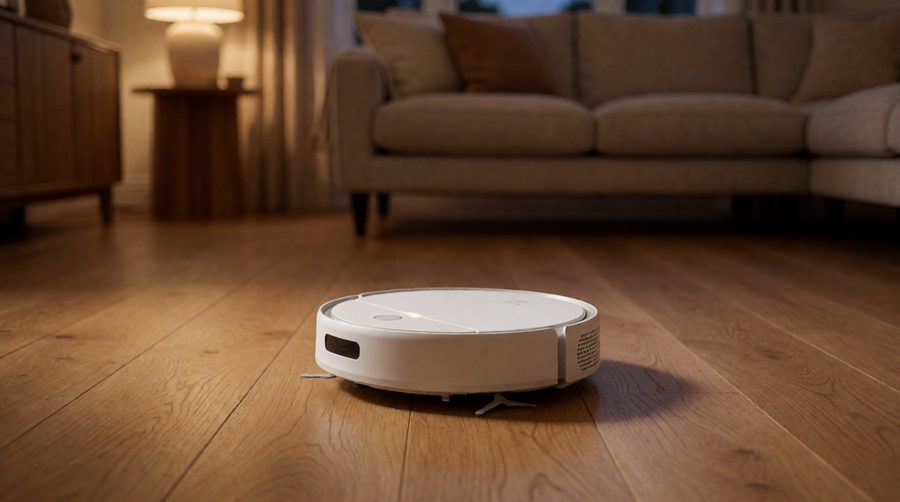
Decibels explained: how loud is 40dB, 55dB or 65dB?
Decibels are a logarithmic scale. A rise of 10dB sounds roughly twice as loud to most people, so a robot at 65dB is not a little louder than one at 55dB - it is about double. Even a 3-5dB gap is easy to hear in a quiet room.
| Noise level | Sounds like | What it means for a robot vacuum |
|---|---|---|
| 40dB | A quiet library, a fridge hum | Fades into the background - fine in the next room to a sleeping baby |
| 50-55dB | A quiet office, soft conversation | Easy to talk or work over; most quiet modes sit here |
| 60-65dB | Normal conversation, a dishwasher | Noticeable, but you will not need to pause a call |
| 70-75dB | A busy road, a running tap close by | Typical of self-emptying docks and older, louder models |
| 80-90dB | An upright or cylinder vacuum | Ecovacs puts traditional vacuums at up to 90dB |
Pitch matters as well as volume. Two cleaners at the same dB can sound very different: a low, steady hum is easy to ignore, while a high-pitched whine or a rattle pulls your attention. Reviews that mention a "whine" are worth reading before you buy.
Why listed dB figures are only a guide
There is no single test method that every brand uses. Some measure at one metre, some further away, and most quote the figure for their quietest setting. Treat the number as a ranking within one brand's range rather than a precise comparison across brands, and expect more noise on carpet, at maximum suction and during self-emptying.
Quiet robot vacuum and mop models compared
These are the in-stock models in this collection that list a noise level, using the figures given on their listings. Note how little suction has to do with noise: the Ecovacs X12 lists 22,000Pa at 61.1dB, while the Xiaomi lists 1,800Pa at 66dB.
| Model | Listed noise | Suction power | Run time | Base station |
|---|---|---|---|---|
| HONITURE G20 PRO | 40dB | 4,500Pa | 150 minutes | Charging dock |
| Tapo RV30C | 53dB | 4,200Pa | Up to 3 hours | Charging dock |
| Shark PowerDetect (AV2810ZE) | 55-60dB cleaning, 70-75dB emptying | Not listed | 110 minutes | 60-day self-empty |
| MAMNV BR151 | 60dB | 1,400Pa | 100 minutes | Charging dock |
| Ecovacs Deebot X12 OmniCyclone | 61.1dB | 22,000Pa | 200 minutes | Bagless, mop washing |
| Ecovacs Deebot X11 OmniCyclone | 61.8dB | 19,500Pa | 200 minutes | Bagless, hot water |
| Ecovacs Deebot T30S Pro | 65dB | 11,000Pa | 180 minutes | Self-empty, 70°C mop wash |
| Xiaomi Robot Vacuum (SDJQR02RR) | 66dB | 1,800Pa | 2.5 hours | Charging dock |
| Narwal Freo X Plus | 71dB | 7,800Pa | Not listed | Auto-empty |

The cheaper models with a plain charging dock tend to list the lowest figures, partly because there is no station to empty a bin or dry the mop pads. If you want hands-off cleaning as well, our budget robot vacuum and mop range has more simple docks, and the bigger stations sit in our all-in-one robot mops with charging stations.

Quiet features by brand
Not every listing gives a noise level, so it helps to know what each brand does to keep its robot vacuum cleaner quiet. These are the brands in this collection and the features their own listings point to.
Ecovacs DEEBOT
Ecovacs lists more dB figures than most: 61.1dB for the DEEBOT X12 Pro Omni and X12 OmniCyclone, 61.8dB for the DEEBOT X11 OmniCyclone and 65dB for the DEEBOT T30S Pro and T30S Combo. Its ZeroTangle brushes on the T30 family and the DEEBOT T50 Pro Omni are designed to stop hair wrapping round the brush, which Ecovacs says keeps the robot quieter. The X12 models use a roller mop (OZMO Roller) rather than spinning mop pads.
Roborock
The Roborock Qrevo Edge 2 lists 25,000Pa of suction, an 8cm-tall body, a zero-tangle dual brush system and 80°C hot water mop washing. Its listing gives no dB figure, but Roborock's app has the Do Not Disturb hours described below, plus per-room suction and water levels.
Eufy
The Eufy X10 Pro Omni pairs 8,000Pa of suction with dual rotating mop pads, a 3 litre water tank, a 2.5 litre dust bag and a listed 180-minute battery life. Lower suction than the flagship models means less fan noise on a normal clean, and its AI obstacle avoidance cuts down on bumps.
iRobot Roomba
The iRobot Roomba Combo j7 uses PrecisionVision navigation to spot cables and pet mess, and lifts its mop onto its back on carpet. The Roomba Combo i8+ adds an auto-empty base that holds up to 60 days of dirt - like any auto-empty dock, that is the loudest part of the routine.
Dreame, Shark and others
The Dreame X50 Ultra and Dreame L50 Ultra both list 180 minutes of battery life with 20,000Pa and 19,500Pa of suction, and the X50 has a DuoBrush anti-hair design. The Shark Stratos uses sonic mopping at 100 scrubs per minute with 360° LiDAR navigation. The Lefant M5 Pro and the Eureka J15 Max Ultra both add hot water mop washing at the dock. None of these lists a dB figure, so read user reviews for real-world noise.
The loudest part is often the base station
A self-emptying dock pulls the dirt out of the robot's dustbin into a bag or bagless bin with a short, powerful blast of suction. It only lasts a few seconds, but it is usually the loudest moment of the whole clean. Shark lists its PowerDetect at 55-60dB while cleaning and 70-75dB while emptying.

Washing and drying the mop pads adds more. Many stations rinse the pads, then run a fan for hours to dry them. The Lefant M5 Pro lets you choose 2, 3 or 4 hours of drying, which is worth shortening if the dock sits in a bedroom or an open-plan living space.
- Put the dock in a hallway, utility room or kitchen rather than next to where you sleep or work.
- Set auto-empty to run only after the last clean of the day, or turn it off at night in the app.
- Choose a shorter drying time, or air-dry the pads, if the fan hum bothers you.
- Compare self emptying robot vacuum and mop models on how often they empty, not just whether they do.
Quiet mode, night cleaning and Do Not Disturb
Almost every robot vacuum has a quiet mode, often called eco or silent. It turns the suction down, which drops the noise level and usually stretches the run time too, so it pairs well with the models in our long battery life robot vacuum mops range. The trade-off is less pick-up on carpet and deep dust, so many people use quiet mode for daily hard floor cleans and a stronger setting once a week.
Do Not Disturb (DND) is a different setting. On Roborock models it runs from 22:00 to 08:00 by default: the robot will not resume a paused clean, its lights dim and its voice prompts go quieter. Other brands have similar night settings in their apps, and you can change the hours to suit your household.
Battery, power and run time in quiet mode
Lower suction uses less power, so a quiet mode clean usually runs for longer on one charge. The Lefant M5 Pro shows how much the setting matters: up to 320 minutes vacuuming only, but up to 180 minutes when it vacuums and mops together. If your home is big, a robot with a large battery can do the whole floor in quiet mode without going back to its dock to recharge mid-clean.
Can you run a robot vacuum at night?
You can, but think about who is listening. In a house, a quiet robot at 50-55dB on a hard floor downstairs will rarely wake anyone. In a flat, sound travels through floors and party walls, and a robot bumping chair legs at 2am is the kind of noise neighbours notice. Councils can issue warning notices for noise above permitted levels between 11pm and 7am - see gov.uk on how councils deal with noise complaints. A morning or daytime schedule, or a quiet mode clean before bed, is the safer choice.
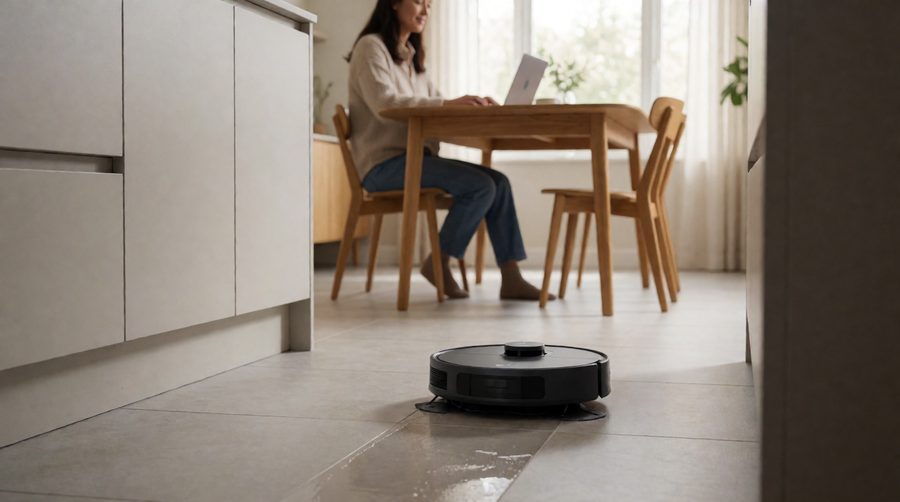
Who needs a quiet robot vacuum and mop?
Flats and shared homes
Hard floors and thin walls carry sound. A quiet robot vacuum lets you clean while neighbours are home without complaints. Space is often tight too, so a slim model with a small dock helps - see our small robot mops for compact options.
Babies, light sleepers and shift workers
A robot at 40-55dB can run in the next room during a nap. Set no-go zones in the app to keep it out of the nursery or bedroom altogether - a feature covered in our guide to robot vacuum and mop with mapping.
Working from home
Under about 60dB, most people can take a video call while the robot cleans another room. Schedule it for your lunch break, or start it from the app or Alexa when you step out.
Nervous pets
Many cats and dogs dislike the noise of an upright vacuum. A quieter robot that cleans every day at the same time is easier for them to get used to. Pet hair wraps round brushes and makes them louder, so look at our robot vacuum and mop for pet hair picks with brushes built to resist hair.
Carpets, rugs and hard floors: how your home changes the noise
The same robot vacuum sounds different from room to room. On hard floors such as laminate, tiles and wood, the fan is the main sound, but hard surfaces also bounce noise around an empty room. On carpet, most robots switch on carpet boost and turn the suction up, which is the loudest thing they do in normal cleaning.
- Hard floors - quiet mode is usually enough for daily dust and crumbs, and the mop pads can do their job on a low water flow setting.
- Rugs and carpet - expect more noise from carpet boost. Turn boost off in the app for rooms where noise matters, or schedule carpet rooms for when you are out.
- Thresholds and furniture - a robot that struggles over door bars or gets stuck under the sofa makes more noise than one that moves smoothly.
For homes that are mostly hard floors, our robot mops for hard floors are a good next step.
How to choose a quiet robot vacuum and mop
- Check the listed dB - under 55dB is quiet, 55-65dB is average, over 65dB is on the loud side for a robot. Be wary of listings that only say "low noise" with no figure.
- Look for separate figures - a maker that lists cleaning and self-emptying noise separately, as Shark does, is giving you a fuller picture.
- Roller type - rubber rollers stay quieter than bristles and keep their noise level as they age.
- Navigation - LiDAR mapping and obstacle sensors mean fewer bumps into furniture. A robot that crashes around is noisier than its dB rating suggests - see our obstacle avoidance robot vacuums.
- Your floors - carpet makes most robots boost suction, so a home that is mostly carpet and rugs will hear more of the fan. Hard floors, laminate and tiles suit quiet mode best.
- App control - scheduling, quiet hours and per-room suction levels let you keep noise down where it matters.

Look out for the Quiet Mark logo too. It is an independent award run with the UK Noise Abatement Society's charitable foundation, set up in 1959, and it marks the quietest products in a category. For a wider checklist covering navigation, mopping and running costs, the Which? robot vacuum buying guide is a good starting point.
Keeping a robot vacuum quiet over time
A quiet robot can get noisy if it is not looked after. Most of the extra noise comes from parts you can clean in minutes:
- Cut hair and thread off the main brush and side brush every week or two - wrapped hair makes the motor work harder.
- Empty the dustbin and tap out or rinse the filter as the manual says. A blocked filter makes the fan whine.
- Check the wheels for wrapped hair and grit, which cause clicking and grinding.
- Wash or replace mop pads so they glide rather than drag.
- Replace worn brushes and filters on the maker's schedule.
If a robot suddenly gets louder, a blockage is the most likely cause. Check the roller, the suction inlet and the dustbin before contacting the seller.
Frequently asked questions
What is the quietest robot vacuum and mop?
In this collection, the HONITURE G20 PRO lists the lowest figure at 40dB, followed by the Tapo RV30C at 53dB. Among the big all-in-one models, the Ecovacs Deebot X12 range lists 61.1dB. Brands measure differently, so use these as a guide.
What dB is quiet for a robot vacuum?
Under 55dB is quiet - about the level of soft conversation. 55-65dB is typical. Anything over 65dB is loud for a robot vacuum, though still well below an upright vacuum cleaner.
Do quiet robot vacuums clean less well?
Not necessarily. Noise depends on the fan, insulation and brushes as much as on suction. Quiet mode does reduce pick-up, so use a stronger setting for carpets and deep cleans.
Is a robot mop quieter than vacuuming?
The mop pads themselves make a soft hum. Most of the noise comes from suction, so a mop-only run with the fan on its lowest setting is usually the quietest way to clean hard floors.
Why is my robot vacuum louder than it used to be?
Usually hair round the brush, a full dustbin, a clogged filter or debris in a wheel. Clean those first. If it still sounds wrong, a worn brush bearing or motor may need replacing.
Can I use a quiet robot vacuum and mop in a flat at night?
You can, with quiet mode and a gentle schedule, but sound travels through floors. A daytime or early-evening clean is kinder to neighbours, especially between 11pm and 7am.