

Refine
Sort by
Base station
Suction power
Navigation
Battery life
Smart features
Colour
Brand
Customer rating
More like this
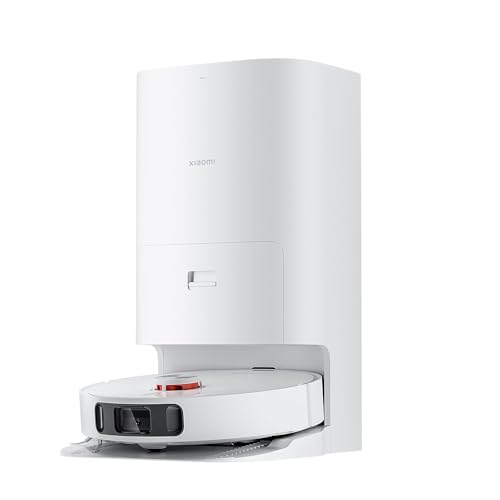
Xiaomi Mi Robot Vacuum Cleaner X10+
Xiaomi
- 4000Pa super suction power
- Self-cleaning rotating mop pads
- Auto-empty dust station
- AI obstacle avoidance technology
- 120-minute battery life
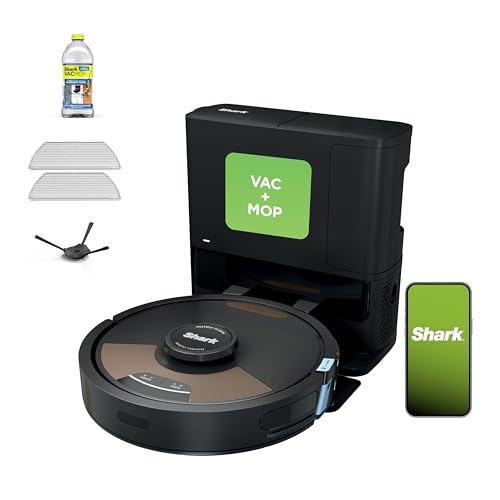
Shark Matrix Plus
Shark
- Self-emptying 60-day capacity
- Sonic mopping technology
- Matrix Clean grid pattern
- HEPA filtration system
- 360° LiDAR mapping

Shark PowerDetect Robot Vacuum
Shark
- 5x PowerDetect cleaning technologies
- 60-day self-emptying capacity
- 3D LiDAR navigation mapping
- Sonic mopping with pad washing
- NeverStuck threshold climbing technology
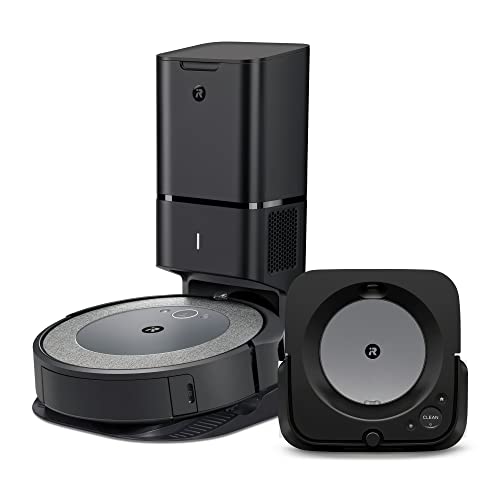
Irobot Roomba i3+ EVO 3550 Bundle
iRobot
- Self-emptying Clean Base station
- Smart mapping technology
- Premium 3-stage cleaning system
- Precision Jet Spray mopping
- Voice and app control
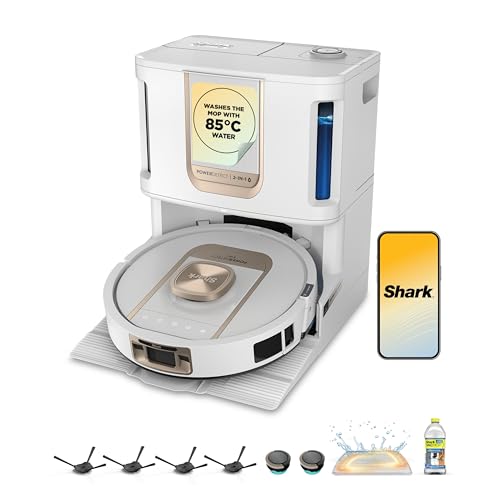
Shark ThermaCharged PowerDetect Robot Vacuum
Shark
- Heated mop cleaning base
- Dirt detect technology
- Edge cleaning extension
- Three hour battery life
- Auto water tank refill

Narwal Freo X Plus Robot Vacuum And Mop (White)
Narwal
- 7800Pa powerful suction
- Seven weeks dust storage
- Zero tangle brush design
- Self-emptying dustbin technology
- Tri-laser obstacle avoidance

Dreame X50 Ultra
Dreame
- 20,000Pa Vormax suction power
- Retractable legs climb 2.36in
- VersaLift lowers to 3.5in
- DuoBrush anti-tangle system
- Auto-empty self-cleaning base

Ecovacs Deebot X11 OmniCyclone
Ecovacs
- 19,500Pa BLAST suction power
- Bagless auto-empty station
- OZMO ROLLER 2.0 mopping
- PowerBoost 3-minute charging
- ZeroTangle anti-hair wrap

Eufy X10 Pro Omni
Eufy
- 8,000 Pa powerful suction
- Auto mop washing station
- Self-emptying dust collection
- AI obstacle avoidance
- Dual rotating mop pads

Shark PowerDetect Robot Vacuum
Shark
- 60-day self-emptying base
- PowerDetect cleaning technologies
- 3D LiDAR navigation
- NeverStuck lifting technology
- Anti-allergen complete seal

Shark PowerDetect robot vacuum
Shark
- 30-day self-emptying base
- Vacuum and mop combo
- 3D LiDAR mapping
- Anti hair wrap technology
- App and voice control

Irobot Roomba Combo i8+
iRobot
- Self-emptying clean base
- Vacuum and mop combo
- Smart mapping technology
- Voice control compatible
- Four stage cleaning

Irobot Roomba Combo j7
iRobot
- Retractable mop system
- PrecisionVision obstacle avoidance
- Smart mapping technology
- 4-stage cleaning system
- Voice control compatible

Irobot Roomba Combo 10 Max
iRobot
- 4-stage cleaning system
- AutoWash dock included
- SmartScrub mopping technology
- Auto-retract mop system
- Advanced obstacle avoidance
What is a self-emptying robot mop?
A self-emptying robot mop is a 2-in-1 robot vacuum cleaner with a mop that parks on a dock with its own dirt store. When a cleaning run ends, the robot drives back onto the base, and a strong fan in the base pulls the hair, crumbs and debris out of its onboard dustbin into a sealed bag or a bagless container. The robot's own bin holds only a few hundred millilitres; the dock holds 2-4 litres, so you deal with dirt every few weeks rather than every day. Think of it as a robot vacuum cleaner that looks after its own bin, with mopping added on top.
The wet side varies far more than the dry side. Some bases only empty the bin, so you still fill the water tank and rinse the pad by hand. Others are full stations that wash the pads, dry them with warm air, refill the robot with fresh water and collect the dirty water too. Both count as self emptying robot mops, but they are very different machines to live with.
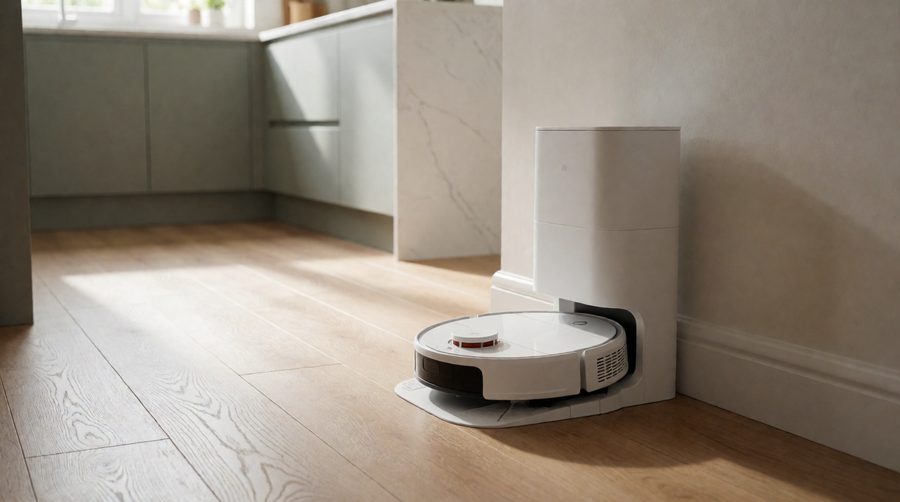
Dust-only dock or all-in-one station?
This is the biggest decision, and it matters more than a headline suction figure.
Dust-only self-emptying docks
A compact base that charges the robot and empties its bin automatically, often sold as an auto-empty base. Mopping is done by a flat or vibrating pad under a small onboard water tank (the Lefant M2 Plus has a 300ml tank). After a wet run you take the pad off, rinse it and let it dry.
- Good for: carpet-heavy homes, small flats, a light wipe of the kitchen and hallway.
- Pros: small footprint, lower cost, fewer parts to clean.
- Cons: pad care and water refills are still your job.

All-in-one stations that wash and dry the pads
Taller stations with clean and dirty water tanks as well as the bag. After mopping, the robot's pads are scrubbed on a wash tray, often with hot water, then dried with warm air so they don't smell. Many top the robot up with fresh water and add cleaning solution automatically. Our all-in-one robot mops with charging stations and self-cleaning robot vacuum and mop collections focus on this type.
- Good for: homes with lots of hard floors, families and pet owners who mop most days.
- Pros: the most hands-off cleaning, hygienic pads, no daily refills.
- Cons: big dock, higher price, two water tanks to look after.

Bagged or bagless docks
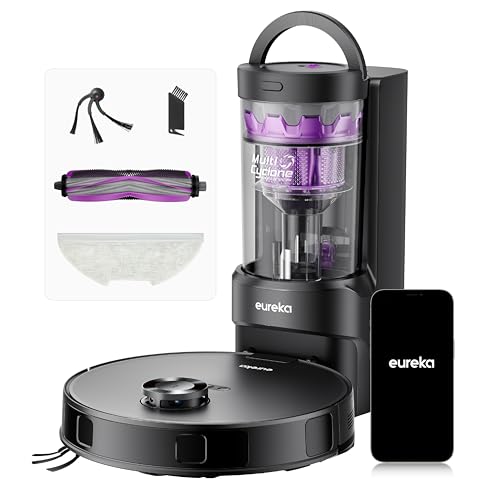
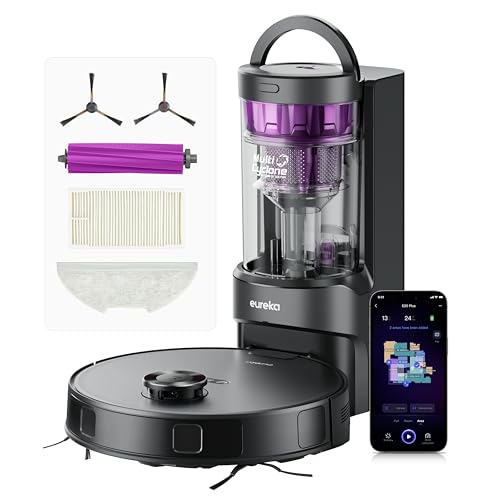
Bagged bases seal everything inside a disposable liner, so you lift it out and bin it with little mess. You do need to buy replacements. Bagless docks, such as the transparent base on the Eureka E20 Evo Plus or Ecovacs' OmniCyclone stations, spin the dirt into a container you tip into the bin. They save money on bags, but emptying them is messier, which matters if anyone at home has allergies.
Self-emptying robot mops compared
Real figures from the listings in this collection. Days between empties are manufacturer estimates, so a home with pets or lots of carpet will fill the dock sooner.
| Model | Dock type | Suction | Dock capacity | Pad care at the dock | Runtime |
|---|---|---|---|---|---|
| Tapo RV30 Max Plus | Dust only, bagged | 5,300Pa | 3L bag | None - rinse by hand | 150 min |
| Lefant M2 Plus | Dust only, bagged | 6,000Pa | 2.2L, up to 40 days | None (300ml onboard tank) | 140 min |
| Proscenic Q8 Max+ | Dust only, bagged | 8,000Pa | 3L, up to 60 days | None; pad lifts on carpet | 200 min |
| Eureka E20 Evo Plus | Dust only, bagless | 10,000Pa | Up to 45 days | None; 10mm lift | 180 min |
| Ecovacs Deebot T30S | All-in-one | 11,000Pa | 4L | 70°C wash, hot air dry, auto refill | 180 min |
| Shark PowerDetect AV2810ZEUKWH | All-in-one | Not listed | Up to 60 days | Washes and dries pads | 110 min |
| Eufy E25 Omni | All-in-one | 20,000Pa | 3L, change every 75 days | Washes, dries at 35-50°C | 180 min |
| Dreame L50 Ultra | All-in-one | 19,500Pa | Up to 100 days | Washes, auto-doses 200ml solution tank | 180 min |
| Lefant M5 Pro | All-in-one, roller | 18,000Pa | Up to 120 days | 75°C roller wash, 2-4 hour dry | 180 min (vacuum + mop) |
| Eureka J15 Max Ultra | All-in-one | 22,000Pa | 4L, up to 75 days | 80°C wash, 55°C dry, self-refill | Not listed |
Two things stand out. Dust-only docks cluster at 5,000-10,000Pa and the lower prices, while all-in-one stations start around 11,000Pa and climb past 20,000Pa. And the days between empties range from about 40 to 120, so check the dock's capacity as closely as the robot. For the cheaper end, see our budget robot vacuum and mop picks; for flagship stations, browse premium robot vacuum and mop models.
How to choose a self emptying robot mop
Pick the mopping system first
There are three common types:
- Flat or vibrating pad - light and simple, fine for a quick daily wipe. The Roborock Q10 S5+ vibrates its pad 3,000 times a minute.
- Twin spinning pads - press down harder and cope better with sticky kitchen floors. The Eufy X10 Pro Omni spins at 180 RPM with 1kg of downward pressure.
- Roller - rinsed with fresh water as it turns, so it doesn't spread dirty water around the room, like the 20cm roller on the Lefant M5 Pro.
On sealed wood or laminate hard floors, choose a model with adjustable water flow so the floor never gets too wet, and see our guide to robot mops for hard floors.
Check how long the base goes between empties
Capacity is the best clue: 2-2.5 litre docks tend to be quoted at 40-45 days, 3-4 litre bags at 60-75 days, and a few stations claim 100-120 days. With a long-haired dog, a shedding cat or daily schedules, expect less. If you want to touch it as little as possible, look for 3 litres or more.
Suction, brushes and pet hair
Suction is listed in pascals (Pa): around 5,000 Pa is entry level, 10,000 Pa is mid-range and 20,000 Pa or more is flagship. Higher numbers help on rugs and with fine grit, but brush design matters just as much for pet hair and long human hair. Look for anti-tangle rubber or comb-style brushes and a side brush that sweeps debris out of corners; the Roborock Q10 S5+ uses a dual anti-tangle system and the Eureka E20 Evo Plus a V-shaped roller. With pets, a self-emptying dock really earns its keep, because a small onboard bin fills fast with pet hair. Our robot vacuum and mop for pet hair collection goes further.
Carpets and pad lift
A robot vacuum that mops in the same pass has to keep the wet mop pad off your rugs, and good carpet detection is what makes vacuuming and mopping in one run work on mixed floors. Most models lift the pads when sensors detect carpet: 8mm on the Roborock Q10 S5+, 10mm on the Eureka E20 Evo Plus, 10.5mm on the Dreame L50 Ultra and 12mm on the Eufy X10 Pro Omni. That clears low-pile rugs, but deep pile still needs a no-go zone in the app. With a dust-only dock you can simply take the pad off before a carpet run.
Dock size and where it goes
Measure before you buy. Dust-only bases are compact, but all-in-one stations are big: the T30S station measures 39.5 x 44.5 x 52.8cm and the Roborock Qrevo Edge 2 dock 48.7 x 52.1 x 34cm. The robot needs a clear, straight approach, a nearby socket and room above it to lift out the water tanks. Thresholds matter too; the Tapo RV30 Max Plus climbs up to 22mm, and if your doorways have raised bars, see our robot vacuums that climb thresholds.

Noise of the empty cycle
Robots are fairly quiet while cleaning the floor, but the dock's emptying blast is short and loud, like a full-size upright for a few seconds. Shark lists its PowerDetect at 55-60 dB cleaning and 70-75 dB during self-empty. If the dock sits near a bedroom or you run the robot at night, use the app's do-not-disturb hours, or browse our quiet robot vacuum and mop range.
App, navigation and voice control
LiDAR navigation is now standard even on cheaper robot vacuum cleaners, and the app lets you clean room by room, set no-go zones and schedule runs. Camera-based obstacle avoidance on higher-end robots spots socks, cables and pet mess, and good obstacle avoidance means fewer rescues mid-clean: the Eufy E25 Omni recognises 200+ obstacles and the Roborock Qrevo Edge 2 280+ object types. For a house on two floors, multi-floor mapping saves a map per level (the Proscenic Q8 Max+ stores 5); the dock stays on one floor, so you carry the robot up. See multi-floor robot vacuums and robot vacuum and mop with mapping. Most work with Alexa and Google Assistant.
Brands worth knowing
Roborock
Strong navigation and some of the most capable stations. The Roborock Qrevo Edge 2 pairs 25,000Pa suction with a dock that washes pads at 80°C, dries at 55°C and holds up to 65 days of debris; the Q10 S5+ is the simpler dust-only option with a 2.7L bag.
Dreame
Dreame's Ultra stations do almost everything, from hot water mopping to self-cleaning and auto-dosing. The Dreame L50 Ultra quotes up to 100 days between empties, and the Dreame D20 Air Plus offers 20,000Pa and up to 120 days in a much smaller dust-only base. Most Dreame robots also have strong edge cleaning and good navigation for the money.
Eufy and Ecovacs
Eufy's Omni stations (E25 Omni, X10 Pro Omni) are well priced for what the dock does. Its Omni models such as the T30S use hot water washing and hot air drying, and its OmniCyclone stations are bagless.
Shark, Eureka and Lefant
Shark's PowerDetect range keeps docks fairly compact. Eureka and Lefant offer the most self-emptying for the money, from the 2.2L Lefant M2 Plus to the 75-day Eureka J15 Max Ultra.
Dyson and Kärcher
Newer to the category. Dyson's Spot+Scrub Ai uses a cyclonic dock that Dyson says stores dry dirt for up to 100 days, and Kärcher sells robot vacuum and mop models with multifunctional stations. Neither is in this collection yet.
Upkeep and running costs
Self-emptying removes one chore, not all of them. Plan for:
- Replacement bags - one every 40-75 days on a bagged dock. Buy the maker's own or a well-reviewed compatible pack.
- Filters - the robot's filter and, on some docks, a second filter in the base. Tap out or replace when the app reminds you.
- Brushes - cut hair off the main brush and replace the side brush when its bristles splay.
- Mop pads - washable mop pads wear out; most kits include spares.
- Water tanks - on all-in-one stations, refill the clean tank and empty and rinse the dirty water tank every few runs so it doesn't smell.
- Cleaning solution - only use the manufacturer's approved formula in stations that dose it automatically. Our robot mops that use cleaning solution explain more.
A few minutes a week keeps everything working well. Wipe the cliff sensors and the dock's suction port too, as a blocked port stops the robot emptying properly.
Are self-emptying robot mops good for allergies?
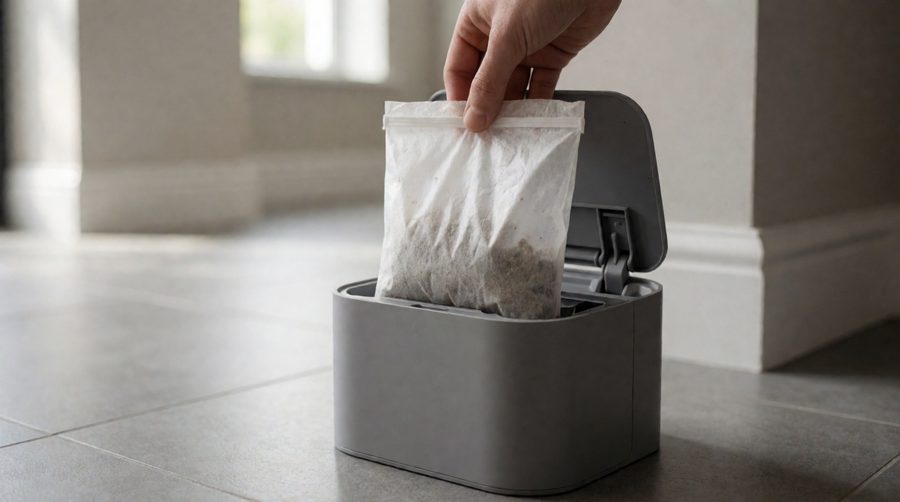
They can help. Advice from Cambridge University Hospitals NHS on dust mites in your home says to vacuum at least once a week and, ideally, for the vacuuming not to be done by the person with the allergy, recommending HEPA-filtered vacuums that don't blow dust back out. A robot that cleans on a schedule, plus a sealed bag you lift out every few weeks, cuts how often anyone handles loose debris. Choose a bagged dock and a HEPA filter: the Shark PowerDetect AV2810ZEUKWH lists an anti-allergen complete seal, and the Eureka E20 Evo Plus has five-stage HEPA filtration.
Which type suits your home?
- Flat or small home, mostly hard floors: a dust-only dock with a simple pad. Small base, low cost, quick to rinse.
- Family home with pets: a bagged dock of 3 litres or more plus anti-tangle brushes. An all-in-one station is worth it if you mop most days.
- Mostly carpet: prioritise suction and a removable or lifting pad; you may not need pad washing at all.
- Big kitchen and lots of tiles: an all-in-one station with hot water washing. See our hot water robot vacuum mops and robot mops with dirty water tanks.
- Two or more floors: multi-floor mapping, and a light robot you can carry.
Still comparing the wider category? Our self emptying robot vacuum and mop guide covers vacuum-first models, and independent lab results are in Which? robot vacuum cleaner reviews.

Self emptying robot mops: FAQs
How often do you empty a self-emptying robot mop?
The robot empties itself after every run. You empty the dock, usually every 40-75 days for 2-4 litres of capacity, or up to 100-120 days on some stations. Pets and daily runs shorten that.
Do self-emptying docks wash the mop pads?
Only all-in-one, self-cleaning stations do. A dust-only base empties the bin but leaves the pad to you. Check the listing for "mop washing", "hot air drying" or "auto refill".
Is a bagged or bagless dock better?
Bagged docks are cleaner to empty and better for allergies; bagless docks cost nothing in bags but are messier to empty.
Are self-emptying robot mops loud?
Only for a few seconds while the dock empties. Shark lists 70-75 dB for that cycle, compared with 55-60 dB while cleaning.
Can a self-emptying robot mop clean carpets?
Yes, it vacuums carpets. Most lift the pads 8-12mm on carpet; for deep pile, set a no-go zone or remove the pad.
Are they safe to leave charging?
These robots use lithium-ion batteries. Use the supplied dock and lead, keep the dock clear of clutter, and follow London Fire Brigade lithium battery advice.
Are self emptying robot mops worth it?
If you'd otherwise empty a tiny bin every day, yes, especially with pets. If you mop often, an all-in-one station saves the most time; if you mostly vacuum, a dust-only dock is cheaper and smaller.